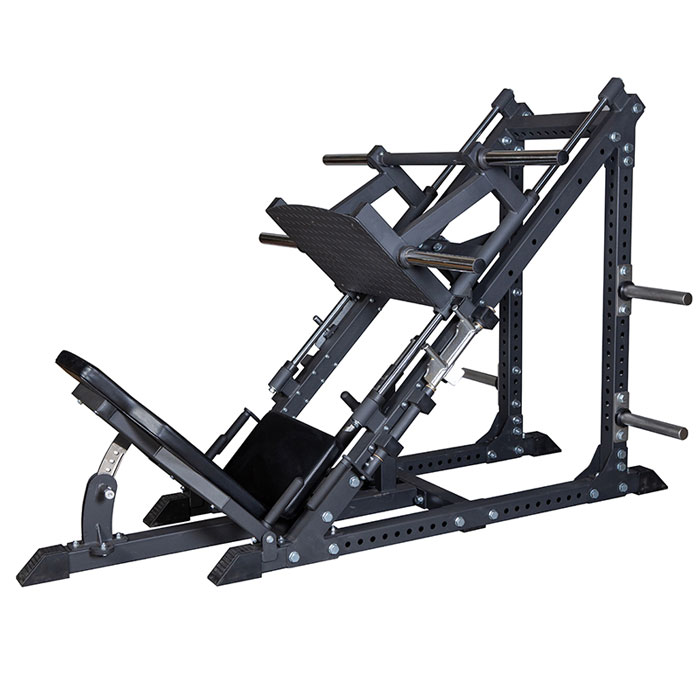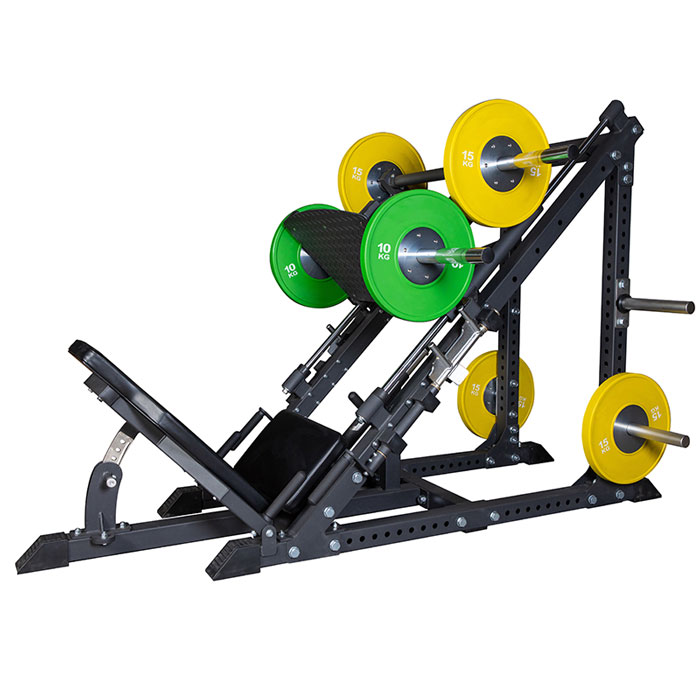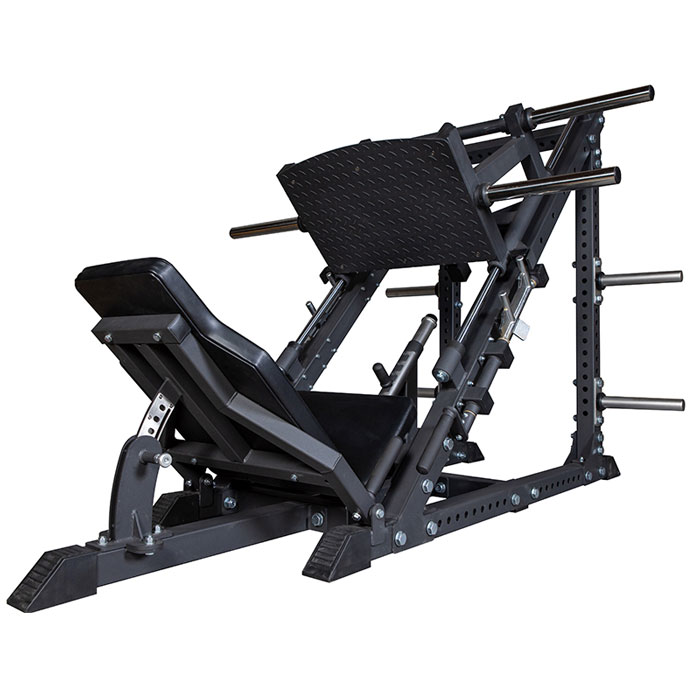
In commercial gym environments, hack squat machines and leg press units typically occupy separate floor spaces. From a training anatomy perspective, each targets different knee and hip mechanics—hack squats emphasize spinal-loaded squatting patterns, while leg presses provide an inclined closed-chain pushing motion. This integrated unit combines hack squat and 45° leg press functions into a single frame, sharing a common carriage system and adjustable seat mechanism. The result is complete lower body coverage: quadriceps, glutes, hamstrings, and adductors can all be trained at high intensity on the same machine.
This integration is not a simple bolt-on of two functions. It is based on ergonomic mechanism design that re-engineers carriage travel trajectory, backrest angle range, and footplate positioning. Mode switching from hack squat to leg press takes approximately five seconds—no tools required, no additional weight horns. For small to mid-sized training studios, hotel fitness centers, or multi-purpose training facilities, this is a highly efficient solution for maximizing value per square foot.
From a biomechanical distinction: Hack squat employs a fixed backrest and shoulder pads. The user's torso remains at a controlled incline while hips and knees flex/extend simultaneously. Load transfers through the shoulder harness to the spine—this pattern significantly activates the vastus lateralis and upper gluteal region. Since the lower back does not need to stabilize against flexion moments, lifters can focus more intently on peak contraction during the concentric phase.Leg press mode positions the user reclined against an adjustable backrest, feet pushing against a platform. Load transfers through the carriage—knee flexion angles become larger, providing concentrated stimulation to the vastus medialis and hamstrings, while spinal shear stress is further minimized.
Having both modes on a single machine means a trainer can complete heavy, low-rep hack squats (emphasizing muscle thickness and absolute strength) and then immediately switch to leg presses for high-repetition metabolic stress training (muscular endurance and pump) without relocating to another station. This seamless transition not only saves time but also maintains continuous tension on the lower body musculature.
| Training Mode | Primary Muscle Activation | Spinal Load Characteristics | Recommended Training Purpose |
|---|---|---|---|
| Hack Squat | Vastus lateralis, upper gluteus maximus | Axial load, low lumbar stabilization demand | Quadriceps strength, glute shaping |
| Leg Press | Vastus medialis, hamstrings, deep gluteal | Very low shear, spine-friendly | High-volume training, post-rehab, endurance |
This machine utilizes 11-gauge structural steel tubing (approximately 3.0mm wall thickness), meeting the entry-level high-load standard for commercial fitness equipment. Compared to thinner 2.5mm or lower tubing, 3.0mm steel offers significantly better bending resistance and weld-joint fatigue life when subjected to repeated loads—the unit's 240kg net weight plus additional plate loads (total working load can reach 400-600kg). The Q235 precision steel counterweight system ensures that the weight carriage and loading horns remain free from deformation or wobbling over years of use—one of the most common failure points in lower-cost integrated machines.
From an operational perspective, this machine serves hundreds of members and endures hundreds of heavy sets weekly. The 3.0mm wall thickness combined with pioneering laser welding technology produces joints that approach the strength of the base metal, eliminating welds as structural weak points. The 240kg net weight translates to a low center of gravity and high stability; even under heavy leg press loads, the machine does not tilt or vibrate.
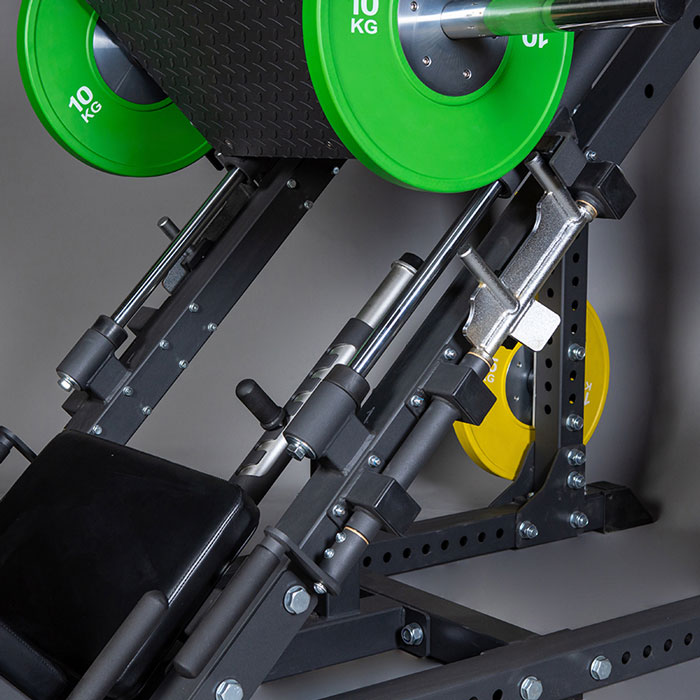
Carriage smoothness is the most immediate quality cue a user experiences on any hack squat or leg press machine. Uneven travel creates resistance waves, catching, or clicking sounds—disrupting training rhythm and potentially increasing joint impact. This product employs laser cutting and precision bending of metal tubes to ensure that straightness, parallelism, and hole-position tolerances for both guide rails are held within extremely narrow limits. High-quality bearings and guide-rail clearances are optimized to deliver low friction while eliminating lateral play.
In testing, resistance variation across the full carriage stroke was measured below 5% on a precision-bent frame, compared to 15-20% variation on conventionally bent frames. This difference becomes especially noticeable during slow eccentric control (the lowering phase)—higher-precision guide rails allow the lifter to control descent speed more accurately, increasing time under tension.
As the primary user-contact interface, back pads and shoulder pads strongly influence stability and comfort. This machine uses soft, wear-resistant leather seat cushions filled with high-density memory foam. In hack squat mode, the shoulder-contact area is thickened; in leg press mode, the lumbar support region contours to the spine's natural curve. The leather surface resists sweat corrosion and cleans easily with standard gym disinfectant wipes.
In hack squat mode, the shoulder pads feature optimized curvature and width to avoid clavicle or acromion pressure while providing sufficient grip texture. In leg press mode, the adjustable backrest allows users of different statures to find a comfortable hip flexion angle, reducing lower back compensation.
Different gyms have distinct spatial visual systems. This machine supports full customization in all aspects: main frame powder-coat colors can be specified to RAL or Pantone codes; upholstery leather colors and stitching styles can be chosen; brand logos can be applied via laser engraving, metal nameplates, or silk-screening; weight-horn lengths and starting heights can also be adjusted for specific training populations. For chain brands or premium boutique studios, this ensures visual consistency with the overall space design language.
In cross-border or regional shipping of commercial fitness equipment, packaging quality directly determines arrival condition. The machine is shipped in a wooden case, with high-density foam padding and nylon straps partitioning the main frame, accessories, and documentation to prevent impact damage during transit. The wooden case meets ISPM 15 international phytosanitary standards for smooth customs clearance at most ports. The unit is largely pre-assembled at the factory; only shoulder pads, seat cushions, decorative covers, and weight horns require final on-site installation. Two technicians typically complete unpacking, positioning, and assembly within 60-90 minutes.
| Specification Category | Technical Details |
|---|---|
| Product Name | Plate Loaded Hack Squat & Leg Press Integrated Trainer |
| Primary Function | Leg & Hip Exercise (quads, hamstrings, glutes, adductors) |
| Frame Material | 11-gauge structural steel + Q235 precision steel |
| Tube Wall Thickness | 3.0 mm (main structural frame) |
| Net Weight | 240 kg |
| Overall Dimensions (L×W×H) | 2210 × 1710 × 1610 mm |
| Transmission Components | High-quality industrial bearings for smooth linear motion |
| Key Manufacturing Processes | Laser cutting, precision bending, laser welding |
| Seat Material | Soft wear-resistant leather + high-density foam |
| Customization Options | Color, leather, logo (OEM available), weight horn details |
| Packaging | Wooden case (ISPM 15 compliant) + foam and strap internal restraint |