
How Integrated Storage Prevents Gym Floor Clutter
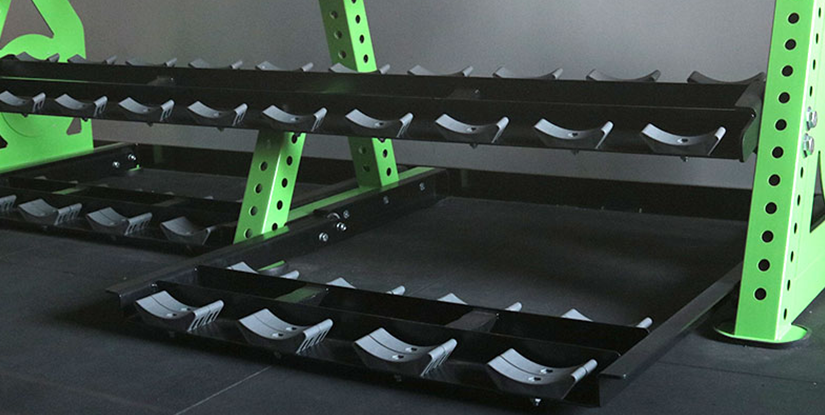
The High Cost of Unorganized Training Floors
Facility managers often encounter a recurring nightmare: the 'obstacle course' effect. This occurs when loose dumbbells, kettlebells, yoga mats, and medicine balls migrate from their designated zones into high-traffic movement paths. This clutter is not merely an aesthetic issue; it is a significant operational liability. Unorganized equipment leads to increased trip-and-fall incidents, creates psychological friction for members, and slows down the cleaning crews who must navigate around debris to maintain sanitary standards.
The root cause of this clutter is rarely a lack of discipline among members, but rather a failure in the architectural logic of the equipment layout. When storage is treated as an afterthought—using standalone racks that are disconnected from the primary training stations—there is a natural tendency for equipment to stay where it was last used. To resolve this, operators must transition from 'scattered storage' to 'integrated ecosystems' where the storage unit and the training tool are functionally inseparable.
Identifying Clutter-Induced Risks
- Tripping Hazards: Low-profile items like kettlebells left in transition zones.
- Equipment Degradation: Rubber weights left on hard floors without protective housing.
- Member Attrition: A perceived lack of professionalism due to a chaotic environment.
Related reading:
The Mechanics of Integrated Storage Systems
Integrated storage refers to equipment designed with built-in housing specifically tailored to the geometry and weight of the tools being used. Unlike traditional freestanding racks, integrated units are often structurally connected to the functional training rigs, weight trees, or even the flooring systems themselves. This creates a single, cohesive unit that dictates exactly where an object belongs.
The mechanism of prevention works through spatial restriction and visual cues. When a medicine ball has a dedicated, recessed cradle within a power rack, the 'path of least resistance' for a member is to return it to that cradle rather than dropping it on the floor. This structural integration reduces the cognitive load required to tidy up, making organized behavior the default setting for the facility.
Structural Logic and Load Distribution
Professional-grade integrated units are engineered to handle much higher lateral and vertical loads than standard shelving. Because these units are often part of a larger frame, they benefit from the stability of the entire rig. This allows for the storage of heavy, high-density items like bumper plates and heavy dumbbells in locations that do not compromise the center of gravity of the main station.
Related reading:
Evaluating Material Selection for High-Traffic Zones
Choosing the wrong material for integrated storage can lead to rapid wear and premature failure. In a commercial gym environment, storage components are subjected to constant impact, heavy friction, and potential chemical exposure from cleaning agents. Operators must prioritize durability over initial cost to avoid the cycle of frequent replacement.
When selecting integrated components, look for high-gauge steel with powder-coated finishes. This is crucial because the contact points between the equipment and the storage unit are high-friction areas. If the finish is too thin, the constant sliding of metal weight plates will quickly strip the coating, leading to oxidation and rust.
| Material Component | Ideal Specification | Failure Mode if Low Quality |
|---|---|---|
| Frame Construction | 11-gauge or 12-gauge steel | Structural buckling under heavy load |
| Surface Coating | Electrostatic powder coating | Peeling and oxidation due to friction |
| Padding/Liners | High-density EVA or TPU | Cracking and compression set |
| Weight Hooks/Cradles | Reinforced steel with rubberized lining | Scratches on equipment and noise |
Strategic Layout and Floor Plan Optimization
Implementing integrated storage requires more than just purchasing new racks; it requires a systematic redesign of the floor plan. The goal is to create 'zones of utility' where the transition from a workout to a cleanup is seamless. If a member completes a set of kettlebell swings, the integrated kettlebell station should be within their immediate peripheral vision and easy reach.
A common mistake is placing integrated storage too far from the functional area it serves. For example, if a functional trainer has an integrated pull-up bar but no integrated storage for resistance bands or suspension trainers, the bands will inevitably end up draped over the handles or left on the floor. The storage must match the activity frequency of the station.
Step-by-Step Implementation Checklist
- Audit Current Usage: Identify the top 5 items that are most frequently found 'out of place.'
- Map Movement Paths: Ensure that integrated storage units do not narrow the clearance of primary walkways.
- Define Station Boundaries: Use floor markings or textured matting to reinforce the perimeter of the integrated unit.
- Test Accessibility: Verify that users of different heights can easily access both the top and bottom storage tiers.
Maintenance Protocols for Integrated Systems
Even the most robust integrated storage systems require regular inspection to ensure they remain safe and effective. Because these units are often part of larger structures, a failure in a single storage component can potentially affect the stability of the entire rig. Maintenance is not just about cleanliness; it is about structural integrity.
Operators should implement a tiered inspection schedule. Daily checks should be performed by floor staff to look for loose items or debris, while monthly deep inspections should be conducted by facility managers to check for structural fatigue. Neglecting these checks can lead to the 'hidden failure' mode, where a weld or a bolt loosites under the weight of a heavy dumbbell, unnoticed until a member interacts with it.
The Routine Inspection Framework
To maintain peak performance, follow this hierarchy of checks:
- Daily: Visual Scan. Are all items in their designated cradles? Is there any visible debris in the storage recesses?
- Weekly: Fastener Check. Are there any loose bolts on the attachment points? Are the weight pegs securely seated?
- Quarterly: Finish and Integrity. Is the powder coating intact? Are there any signs of metal fatigue or rust at the welding points?
Common Mistakes in Integrated Storage Procurement
The most frequent error made by gym owners is purchasing 'modular' equipment that is actually 'disconnected.' Modular equipment implies that parts can be moved, but in a high-intensity commercial environment, truly modular pieces often lack the heavy-duty integration required to prevent clutter. They end up being just another piece of freestanding equipment that can be moved around and subsequently ignored.
Another significant mistake is ignoring the 'footprint vs. capacity' ratio. Some integrated storage units look impressive but offer very little actual usable depth. This results in equipment hanging off the edges, creating a new set of snagging hazards. Always verify the depth and weight-bearing capacity of the specific storage tier before finalizing a purchase.
| Mistake Type | Description | Professional Solution |
|---|---|---|
| The 'Disconnection' Error | Buying storage that isn't physically attached to the rig. | Select units with unified structural welding or bolted integration. |
| The 'Depth' Oversight | Ignoring the clearance required for heavy/bulky items. | Measure the largest item's diameter plus 20% for clearance. |
| The 'Aesthetic' Trap | Prioritizing looks over weight-bearing durability. | Demand technical spec sheets for gauge thickness and load ratings. |
Related reading:
Verifying the Success of Your Storage Strategy
How do you know if your investment in integrated storage has actually solved the clutter problem? Success is measured through two primary metrics: the 'Cleanliness Delta' and the 'Member Feedback Loop.' The Cleanliness Delta is the observable difference in the amount of time staff spends tidying up at the end of a shift compared to before the implementation.
If your staff is still spending 20 minutes a day picking up rogue kettlebells, your storage integration has failed to change user behavior. A successful system should make it easier to store the equipment than to leave it on the floor. This is the ultimate litmus test for any facility manager. If the equipment has a 'home' that is more accessible than the 'floor,' the clutter problem is effectively solved.