Dumbbell Manufacturer Standards: A Technical Guide to Production and Quality Control
The Foundation of Durability: Raw Material Selection
Selecting a reputable dumbbell manufacturer begins with understanding the foundational inputs. A primary pain point for gym owners and distributors is the premature degradation of equipment due to substandard metallurgy or low-grade polymers. When a manufacturer utilizes recycled scrap metal with inconsistent impurities, the resulting weights often suffer from structural fragility or uneven density. To avoid these issues, one must understand the specific chemical and physical properties of the raw materials employed at the start of the production cycle.
Cast Iron and Steel Grades
High-quality dumbbells typically utilize high-grade cast iron or carbon steel. The precision of the alloy determines the resistance to chipping and the longevity of the weight under high-impact use. A manufacturer must ensure that the iron used has a consistent carbon content to prevent brittle fractures during the cooling phase.
Polyurethane and Rubber Compounding
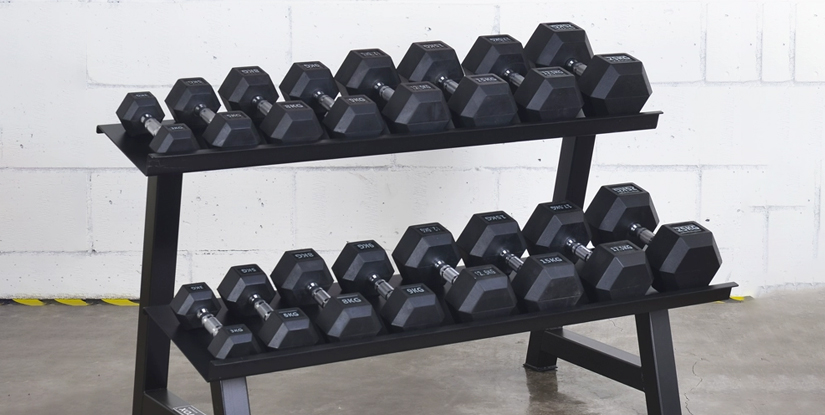
For coated dumbbells, the quality of the elastomer is paramount. Low-grade rubber often experiences 'chalking' or cracking after minimal exposure to UV light or temperature fluctuations. Premium manufacturers use high-density polyurethane (PU) or vulcanized rubber to ensure the coating adheres firmly to the core without peeling or emitting caustic odors.
By securing the right materials, the manufacturer establishes a baseline for all subsequent manufacturing stages, moving from raw elemental input to shaped form.
Precision Casting and Core Formation
Once the materials are vetted, the process shifts to the actual formation of the weight heads. A common failure mode in the industry is the 'hollow core' or air pocket issue, where improper casting leads to an inconsistent center of gravity. This lack of balance can cause significant safety risks during high-repetition training. A professional dumbbell manufacturer utilizes several specialized methods to mitigate these risks.
Sand Casting for Traditional Iron Weights
Sand casting remains the industry standard for economy and mid-tier iron dumbbells. In this process, a pattern is used to create a mold in sand, and molten metal is poured into the cavity. The critical variable here is the grain size of the sand and the temperature of the pour, which directly affects the smoothness of the final surface.
Injection Molding for High-End Polyurethane
For modern, commercial-grade equipment, injection molding provides a much higher level of precision. The liquid polymer is injected into a heated mold at high pressure, ensuring that the weight fills every detail of the design. This method results in a much tighter tolerance and a more aesthetic finish than traditional casting.
| Method | Material Focus | Primary Advantage | Common Failure Mode |
|---|---|---|---|
| Sand Casting | Cast Iron | Cost-effective for bulk production | Air pockets and surface pitting |
| Injection Molding | Polyurethane/Rubber | Precision and high durability | Delamination from core |
| Compression Molding | Vulcanized Rubber | High density and durability | Uneven density distribution |
Effective casting techniques ensure that the geometry of the weight is perfectly symmetrical, which is a prerequisite for the finishing and assembly phases that follow.
Related reading:
Advanced Surface Finishing and Protective Coatings
Achieving a perfect cast is only the first step; the surface must be treated to endure the rigors of a commercial environment. A frequent complaint from end-users is the 'rough texture' or 'flaking paint' found on poorly manufactured units. This is rarely a result of the weight itself, but rather a failure in the surface treatment and coating application process.
Abrasive Sandblasting and Buffing
To achieve a smooth hand-feel, the manufacturer must perform mechanical surface preparation. Sandblasting removes the oxidation layer and the irregularities left by the casting mold. A high-quality manufacturer will use progressively finer grits to ensure the surface is consistent before any coating is applied.
Electrostatic Powder Coating vs. Liquid Paint
The method of coloring and protecting the metal determines how the product will age. Electrostatic powder coating is generally superior to traditional liquid spray painting because it creates a thicker, more durable 'skin' that is highly resistant to scratches and impact. This process involves applying a dry powder that is then cured under heat to create a hard, uniform finish.
- Powder Coating: High impact resistance, uniform thickness, minimal chemical leaching.
- Liquid Paint: Lower cost, thinner layer, prone to chipping under heavy use.
A smooth, well-coated surface not only looks professional but also prevents the onset of oxidation and rust, ensuring the equipment remains usable for years. However, even the best finish cannot hide a poorly constructed core.
Related reading:
The Criticality of Weight Tolerance and Calibration
Regardless of how impressive a dumbbell looks, its primary function is to provide a specific mass. The most significant technical failure in the manufacturing industry is 'weight drift,' where a 20kg dumbbell actually weighs 19.4kg or 20.6kg. This lack of accuracy can disrupt professional training protocols and lead to buyer dissatisfaction. A professional dumbbell manufacturer implements a multi-stage calibration process to ensure strict adherence to weight tolerances.
Measurement Protocols and Calibration Standards
Manufacturers use high-precision digital scales calibrated to international standards to verify each unit. A standard tolerance for commercial-grade dumbbells is typically within +/- 1% to 2%. Any unit falling outside this threshold must be rejected or re-processed.
Center of Gravity and Balance Verification
It is not enough for the total mass to be correct; the distribution of that mass must be perfectly centered. If the internal core is offset, the dumbbell will feel 'lopsided' during movement. Manufacturers use rotational testing or specialized balancing jigs to ensure the center of gravity is aligned with the handle axis, preventing erratic movement during exercise.
| Metric | Target Tolerance | Verification Method |
|---|---|---|
| Total Mass | +/- 1% of stated weight | High-precision digital scale |
| Symmetry | Uniformity across axes | Visual and rotational testing |
| Handle Grip Integrity | Zero movement/slippage | Manual torque/stress test |
Rigorous calibration ensures that the physical reality of the product matches the technical specifications, setting the stage for the final assembly of the handles and end-caps.
Handle Integration and Structural Integrity
The connection between the weight head and the handle is the most critical safety point of the product. A failure in this area—such as a handle coming loose or the weight head detaching—is a catastrophic failure that can cause serious injury. This is where the precision of the casting meets the strength of the hardware.
Threading and Connection Types
Dumbbells generally utilize two types of connections: fixed-diameter threaded handles or solid-core integrated handles. For threaded versions, the manufacturer must ensure that the threads on both the handle and the weight head are perfectly matched (e.g., metric or imperial precision) to prevent stripping. For integrated versions, the welding or molding must be seamless to prevent a point of weakness.
Material Selection for Handles
<Steel/Chrome/RubberizedThe handle is the primary interface between the human and the machine. A common mistake in manufacturing is using low-grade chrome plating that flakes off, or a knurling pattern that is too shallow to provide a secure grip. High-quality manufacturers use high-carbon steel for the handle and apply deep, consistent knurling to enhance grip friction without causing skin abrasion.
With the weights and handles securely integrated, the final product undergoes a series of rigorous inspections before it leaves the factory floor.
Related reading:
Identifying and Preventing Common Manufacturing Defects
Even with advanced machinery, errors can occur. Understanding the common defects helps buyers and quality assurance teams to quickly identify whether a manufacturer's standards are slipping. A professional approach involves identifying the 'why' behind the defect to implement a permanent fix.
Common Defect Checklist
The following table highlights the most frequent issues encountered in low-to-mid tier production and the technical causes behind them.
| Defect Name | Visual Symptom | Root Technical Cause |
|---|---|---|
| Delamination | Coating peeling away from core | Poor surface adhesion or cheap adhesive |
| Surface Pitting | Small holes on the metal surface | Gas bubbles trapped during casting |
| Imbalanced Weight | Lopsided feel during rotation | Uneven material distribution in the mold |
| Knurling Erosion | Smoothed-out grip patterns | Substandard steel or improper heat treatment |
By recognizing these patterns, a procurement specialist can better vet a potential manufacturer during the sampling phase. This systematic oversight is the final barrier between a high-quality product and a defective shipment.
Final Procurement Verification and Long-term Value
As we have explored from the initial raw material selection to the final quality check, the manufacturing of a dumbbell is a complex, multi-stage process requiring precision at every level. To successfully partner with a reliable dumbbell manufacturer, one must move beyond looking at the price per unit and instead focus on the technical evidence of their manufacturing capabilities.
The Importance of Sampling and Batch Testing
Never rely solely on a digital catalog. Always request a physical sample from a specific production batch. This sample should be subjected to the weight tolerance and surface finish tests mentioned earlier. A reputable manufacturer will be transparent about their testing protocols and will provide technical data sheets for their materials.
Evaluating the Manufacturer's Capacity
When assessing a partner, look for evidence of integrated production. A manufacturer that controls the casting, the molding, and the coating in-house is much more likely to maintain strict quality control than one that subcontracts each stage to different vendors. Subcontracting often introduces variability that is difficult to trace once a defect appears in the final product.
Ultimately, high-quality equipment is a result of disciplined process management. By understanding the journey from raw iron to a finished, coated dumbbell, you are better equipped to make informed, high-value procurement decisions.