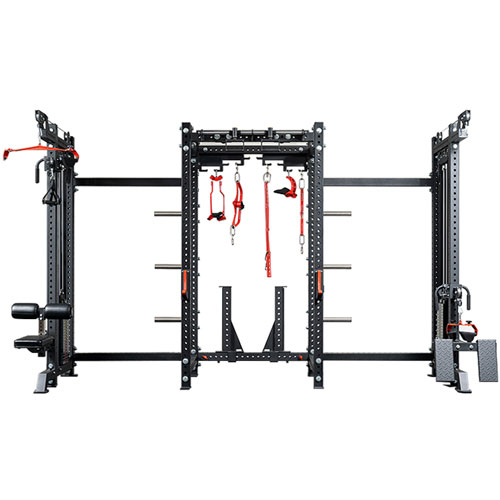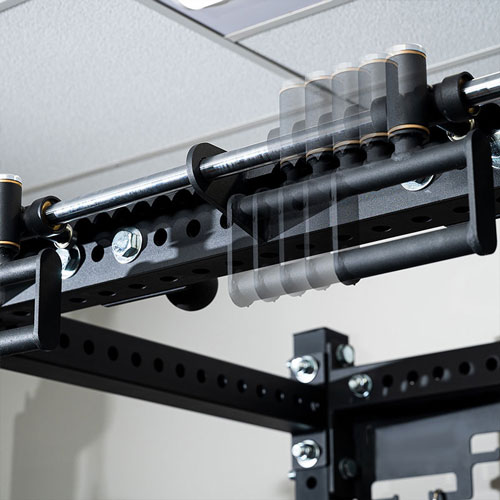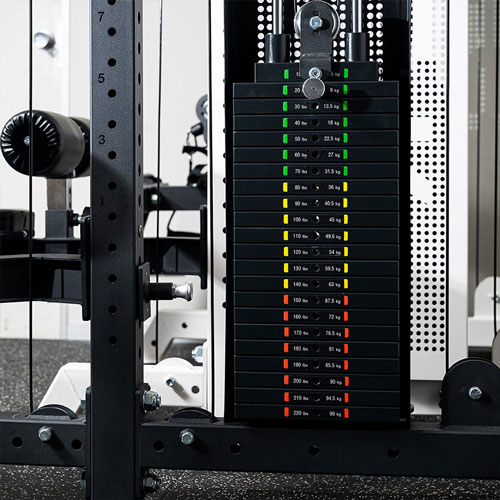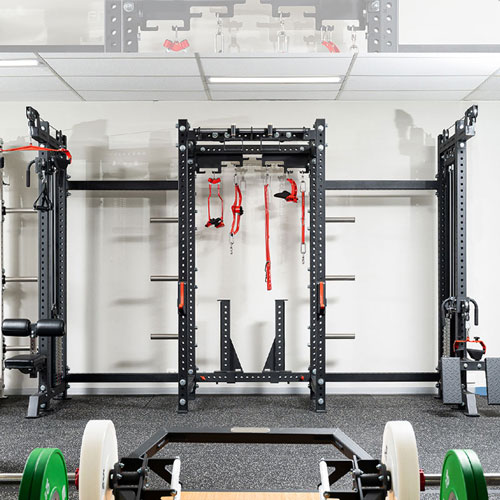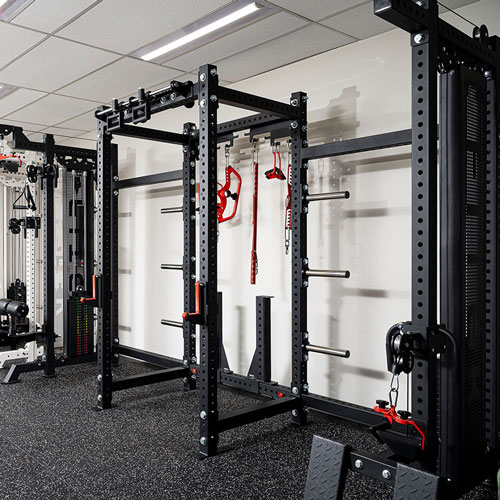
Most power racks are static investments—once installed, their configuration is locked. The multi power cave rejects that limitation entirely. This is a modular rack ecosystem built around 75x75x3mm steel tubing, designed to be reconfigured as training needs evolve. The product philosophy is explicit: "You can build your own setup and swap parts out as required—just like building with Lego blocks." For facility managers, this means a single rack investment can serve multiple purposes over its lifespan, from a basic squat station to a fully enclosed power cave with specialty attachments.
Originating from Shandong's commercial manufacturing sector, this system carries a 2000kg max load rating across all configurations. The 75x75x3mm tube size provides the structural foundation, while the modular connector system allows uprights, crossmembers, and attachments to be rearranged without specialized tools. Unlike welded racks that require complete replacement when facility needs change, the multi power cave adapts through part swaps.
The comparison to Lego blocks is not marketing hyperbole—it reflects a deliberate engineering choice. Standard power racks use fixed hole spacing and proprietary connector sizes, limiting interchangeability. This system uses standardized interfaces across all components. A crossmember from a squat station configuration can be reused as a stabilizer in a half rack configuration. Storage posts can relocate from rear uprights to side mounts. Band pegs, dip attachments, and landmine posts share common mounting brackets.
For commercial facilities running multiple racks, this modularity reduces spare parts inventory. One set of attachments serves multiple rack configurations. When a training program shifts focus—from powerlifting to functional training to Olympic lifting—the rack reconfigures alongside it. The customized logo available option applies across all components, maintaining brand consistency even as the rack evolves.
| Component Type | Configuration Options | Training Application |
|---|---|---|
| Uprights | 2-post, 4-post, or 6-post layouts | Squat stands to full power cave |
| Crossmembers | Horizontal, angled, or multi-pull-up | Structural stability and pull-up stations |
| Storage Attachments | Plate posts, bar holders, dumbbell shelves | Equipment organization and space efficiency |
| Training Attachments | Dip bars, landmine, band pegs, J-hooks | Exercise variety without additional equipment |
| Extension Feet | Standard or extended with band holes | Stability and accommodating resistance |
The product description emphasizes a collaborative process: "You will work with one of our solution specialists to customize your rack from start to finish." This indicates the manufacturer—Leadman from Shandong—provides design consultation, not just order-taking. The specialist helps buyers determine optimal configurations based on facility size, athlete population, and training focus. For a CrossFit box, the specialist might recommend a 6-post cave with multiple pull-up bars and band pegs. For a hotel gym, a compact 4-post configuration with storage integration.
The customization covers three layers: physical dimensions (upright height, rack depth, footprint), attachment selection (which specialty components are included), and finish details (color, logo placement, nameplate design). The MOQ of 1 set means even single-unit buyers—boutique studios, home gym owners, or equipment testers—can access the same customization process as large commercial chains.
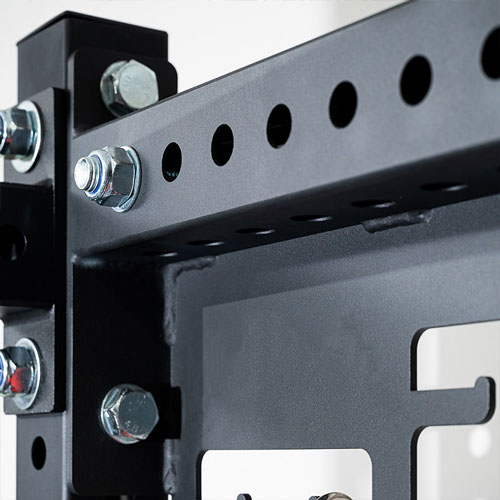
The tube size—75mm square with a 3mm wall—provides the structural margin necessary for modular systems. Welded racks can rely on triangulation for stability; modular racks must achieve the same rigidity through connector design and tube strength. The 3mm wall thickness resists bending at connection points, where modular racks experience the highest stress concentrations. The 2000kg max load rating applies to the assembled system in its most stable configuration (typically a 6-post cave).
For context, a 2000kg rating exceeds the requirements for any standard barbell movement. A 500lb squat (227kg) uses less than 12% of the rack's capacity. Even elite superheavyweight lifters (1000lb squats, approximately 454kg) operate well within the 2000kg safety margin. This over-engineering means the rack's failure point is never the structure—it's always the athlete's limit, which is the correct design philosophy for safety equipment.
| Specification Category | Technical Details |
|---|---|
| Place of Origin | Shandong, China |
| Product Name | Gym Multi Power Cave / Power Rack System |
| Type | Modular Power Rack |
| Tube Size | 75mm x 75mm x 3mm |
| Max Load Rating | 2000 kg |
| Application | Body Building / Commercial Gym / Training Facility |
| Gender | Unisex |
| Packing | Plywood Case |
| Logo Customization | Available |
| Minimum Order Quantity | 1 Set |
The multi power cave set-up concept is best understood through example configurations. A basic configuration might include 4 uprights, 6 crossmembers, 4 J-hooks, 2 safety arms, and plate storage—sufficient for squat, bench, and overhead press. A full power cave adds 2 additional uprights (6 total), band pegs, dip attachment, landmine, and multiple pull-up bars. The system's value is that both configurations use the same component families; buyers start with basic and expand over time.
For commercial facilities with multiple training zones, the modularity allows seasonal reconfiguration. A rack used for powerlifting in winter can be reconfigured for functional training circuits in summer. The plywood case packing protects individual components during sea freight, but more importantly, allows easy repacking if components need to ship between facility locations.
The multi power cave supports the full spectrum of barbell training: back squats, front squats, bench press, overhead press, rack pulls, deadlifts (with open back configuration), pull-ups, dips, landmine rows, banded squats, and belt squats (with additional attachment). The 75x75mm tubing provides sufficient surface area for J-hooks and safety arms to seat securely, while the 3mm wall ensures the lip doesn't deform under repeated loading.
For facility owners, the key metric is versatility per square foot. A single power cave occupying approximately 10-15 square feet (depending on configuration) replaces the need for separate squat stands, deadlift platform storage, pull-up bars, and dip stations. The swap parts out as required feature means the rack is never obsolete—as new training methodologies emerge, new attachments can integrate into the existing frame.
The 2000kg max load rating should be understood as a system rating. Individual components like J-hooks or safety arms may have lower specific ratings, though the 75x75mm frame ensures the limiting factor is always the attachment, not the upright. For competitive powerlifting facilities, this margin matters during rack pulls where 800-1000lb loads are supported entirely by the safety pins and uprights.
| Specification Category | Technical Details |
|---|---|
| Place of Origin | Shandong, China |
| Brand Name | Leadman |
| Product Name | Gym Multi Power Cave / Modular Power Rack System |
| Type | Power Rack (Modular / Configurable) |
| Tube Size | 75mm x 75mm x 3mm |
| Max Load Rating | 2000 kg (approx. 4400 lbs) |
| Application | Body Building / Commercial Gym / Strength Training |
| Gender | Unisex |
| Modularity | Full system — swap components as training needs evolve |
| Assembly Style | Lego-like modular connector system (no welding required) |
| Packing | Plywood Case |
| Logo Customization | Available |
| Minimum Order Quantity | 1 Set |
| Function | Body Building / Power Lifting / Functional Training |