
Redefining Leg Day: The All-in-One Rack Innovation
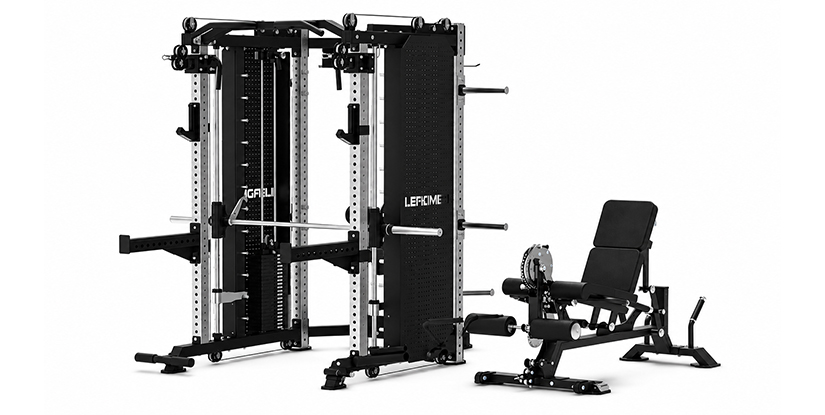
For any professional fitness facility focused on long-term profitability and member retention, equipment investment is fundamentally a strategic calculation of "space efficiency" versus "functional density." Every square meter of rented space and every dollar of procurement cost must translate into measurable member experience and operational returns. Under the traditional approach, a leg training machine (Leg Extension/Curl) and a functional trainer (Smith Machine/Cable System) are often treated as separate line items, each consuming valuable floor space while failing to create a closed-loop training logic.
However, true training value lies in exercise continuity and synergistic muscle stimulation. When a member completes a heavy set of squats and immediately transitions to leg extensions or leg curls to isolate the quadriceps and hamstrings, this is a scientifically validated, highly effective lower body hypertrophy protocol. If these two machines are far apart in the facility, or if the training flow is interrupted by spatial constraints, this "superset" training experience becomes impossible. Commercial gym equipment procurement is evolving beyond buying more single-function machines. The next breakthrough lies in using innovative equipment combinations to "solidify" high-value training patterns into a physically seamless training zone.
This article provides a B2B procurement decision-maker's deep-dive analysis into a new equipment configuration strategy that is transforming ROI for small training studios, high-end hotel gyms, and private training centers: the strategic functional integration of a groundbreaking 3-in-1 Leg Extension and Leg Curl Machine with an All-in-One Functional Training System. This is not merely placing two machines side by side, but a complete, replicable commercial solution for "lower body hypertrophy + full-body functional training."
The Space Efficiency Revolution: Integrating a Leg Machine into a Functional Training Ecosystem
In traditional commercial gym layouts, leg machines—especially seated leg extensions and prone leg curls—are typically isolated in the "single-function machine zone." The flaw in this layout is obvious: the transition cost for members moving between compound movements (like squats and deadlifts) and isolation movements is too high, reducing training efficiency and increasing the risk of chaotic, unsafe floor traffic.
Redefining Functional Density: From "Side-by-Side" to "Mechanical Integration"
The core issue is not the value of leg training itself, but its physical form. When an innovative leg machine (integrating Seated Leg Extension, Seated Leg Curl, and Prone Leg Curl in one unit) ceases to be an isolated island and is designed as an attachment integrated within the frame or extended area of an All-in-One Functional Training System, the entire training ecosystem is fundamentally restructured.
From an operational data perspective, the direct benefit of this "mechanical integration" is a surge in output per square meter. Facilities no longer need to reserve a separate 3-4 square meters for leg curl movements. Instead, after completing Smith machine squats, a member can turn, adjust the seat, and immediately begin leg extension supersets. This space maximization is critical for premium commercial spaces where rent is calculated per square meter.
From a member experience standpoint, this seamless training flow creates a highly professional environment. It sends a clear signal: this facility's equipment configuration is guided by "scientific training logic," not manufacturer categories. This level of professional detail is an effective investment in increasing member retention and building a premium brand image.
The following table compares the differences between traditional standalone equipment layouts and the integrated functional trainer plus leg machine solution across space and operational metrics:
| Comparison Metric | Traditional Standalone Setup | Integrated Trainer + Leg Attachment |
|---|---|---|
| Floor Space Required | Leg Machine ~2.5m² + Trainer ~5m² = 7.5m² | Integrated ~5.5-6m² (shared operating space) |
| Training Flow Interruptions | 2-3 times (moving, waiting, re-adjusting) | 0 times (turn in place to switch) |
| Average Time for Superset Completion | 8-10 minutes (including transition time) | 5-6 minutes (pure training time) |
| Daily Usage per Unit Area | Leg Machine: 8-12 uses, Trainer: 20-30 uses | Integrated area usage increases by ~40% |
Recommended Reading:
Why Gym Weights Matter for Your Business
A systematic guide to evaluating and investing in high-quality commercial fitness equipment
The Technical Core of the 3-in-1 Leg Machine: One Platform, Three Functions, Infinite Possibilities
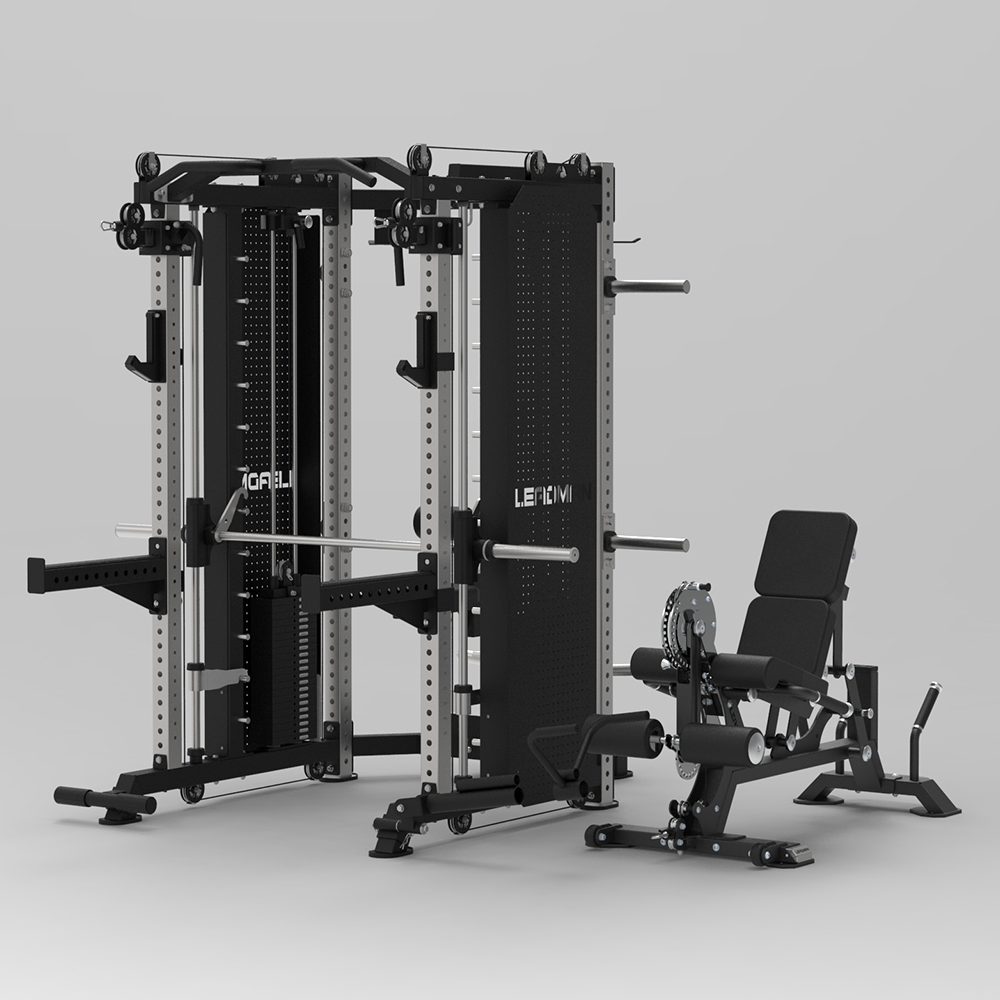
The prerequisite for achieving the above integration is that the leg machine itself must be highly compact and functionally dense. The 8004 model's design philosophy perfectly fits this requirement. It is not just a machine, but a highly integrated lower body training platform, delivering the three most essential leg isolation movements within a minimal physical footprint.
The Biomechanical Logic Behind Three Training Modes
From a sports science perspective, complete leg training is not just about heavy squats and deadlifts. It requires multi-dimensional isolation stimulation for the quadriceps (especially the vastus medialis) and hamstrings (biceps femoris, semitendinosus, semimembranosus). Seated leg extension is a classic movement for stimulating the rectus femoris and vastus lateralis, crucial for building front thigh shape and separation. Seated leg curl and prone leg curl target the hamstrings from different angles, with the prone position more effectively isolating the glutes for more efficient hamstring recruitment.
Integrating these three modes into one machine means facilities no longer need to purchase bulky, space-consuming single-function leg extension and lying leg curl machines. More importantly, members can quickly switch between movement modes on the same seat and same resistance system, executing advanced training techniques like "drop sets" or "pre-exhaustion." This design is decisive for private training efficiency—coaches can deliver more varied training content in less time, directly improving both the per-square-meter and per-person productivity of private training.
Ergonomics and Durability: Core Considerations for Commercial Environments
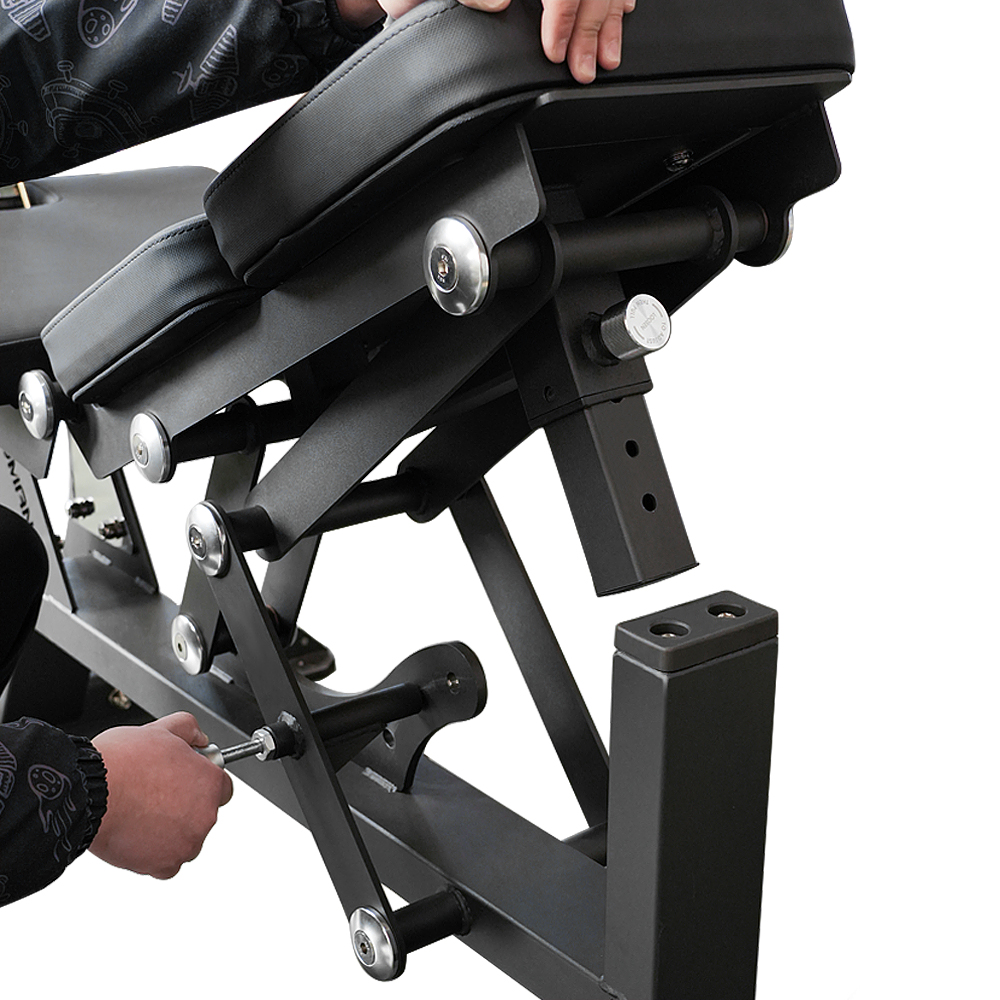
For B2B purchasers, the adjustability and structural durability of equipment directly determine long-term operating costs. The 8004 model features a 4-level adjustable back pad. This design is not just for comfort but for biomechanical alignment. Users of different heights (from 150cm to over 195cm) have vastly different hip joint rotation axis positions. The 4-level adjustment ensures that regardless of user size, the knee joint aligns precisely with the equipment's rotation axis. This is the prerequisite for ensuring training effectiveness and avoiding unnecessary joint stress.
Regarding material selection, non-slip leather upholstery may seem a minor detail, but it is critical in high-intensity commercial use. Standard PU leather typically shows surface cracking or slippage within 6-8 months under sweat and constant friction, forcing premature replacement and increasing maintenance costs. Commercial-grade non-slip leather not only provides a more secure contact surface (preventing body sliding during heavy sets) but also extends upholstery life to 2-3 years due to superior sweat and abrasion resistance.
Explore the complete technical specifications:
8004 3-in-1 Leg Extension and Leg Curl Machine
One machine, three modes, redefining lower body training efficiency
The Multifunctional Rack: A Training Platform Built for Integration
If the 8004 leg machine is the "precision scalpel" for lower body training, then the 9001 All-in-One Functional Training System is the "motherboard" of the entire strength training ecosystem. Its design intent is not simple feature stacking, but rather creating a stable, smooth, and expandable training foundation where high-value attachments like the 8004 leg machine can be seamlessly integrated to form a complete strength training circuit.
The Engineering Foundation of Extreme Stability: F75×3mm Steel Tubing and 30mm Smith Guide Rods
Any integration solution is meaningless without a solid platform. The 9001 model's core strength lies first in its "zero-compromise" frame structure. The main uprights use F75×3mm thickened square tubing, far exceeding the industry standard of 50×50mm or 2mm wall thickness. In practical use, this means when a 100kg user performs 140kg squats on the Smith machine, or when another user performs heavy cable rows on the side, the entire frame produces no perceptible twisting or shaking.
This hardcore structure with zero offset and zero shake is crucial for the long-term stability of accessory integration. The leg attachment generates its own forces and vibrations, transmitted through the connection points to the main frame. If the main frame lacks sufficient rigidity, these vibrations can resonate, accelerating bolt loosening at connection points and shortening the leg attachment's lifespan. The 9001's ultra-rigid frame fully absorbs these dynamic loads, ensuring the integrated structure remains stable for years.
Additionally, the 30mm Smith guide rods are another engineering highlight. The larger diameter provides a greater bearing surface, distributing friction and load more evenly, resulting in smoother and quieter operation than standard 25/28mm guide rod systems. This is particularly critical for integrated solutions, as the leg attachment sits adjacent to the Smith machine area. Any noise or instability from guide rod movement directly affects user focus when using surrounding equipment.
Modular Design: From Fixed Configuration to a Growable Ecosystem
The 9001's modular design is another pillar enabling it to serve as an ideal integration platform. Its assembly method allows purchasers to customize based on their specific floor space and budget. The leg attachment is not an afterthought but a standardized module designed for front or side installation on the weight stack unit.
The business intelligence of this design lies in its DIY compatibility and flexibility. Facilities can first purchase the 9001 main unit as the core strength area. Later, as member traffic grows and user feedback comes in, they can add the 8004 leg module without replacing the entire system. This phased investment approach significantly reduces initial capital expenditure pressure and allows equipment configuration to dynamically adapt to business development needs. No separate storage rack is required—all weight plates and accessories can be stored on the main frame itself, further reinforcing space efficiency. For commercial spaces where every square foot counts, this is a highly compelling value proposition.
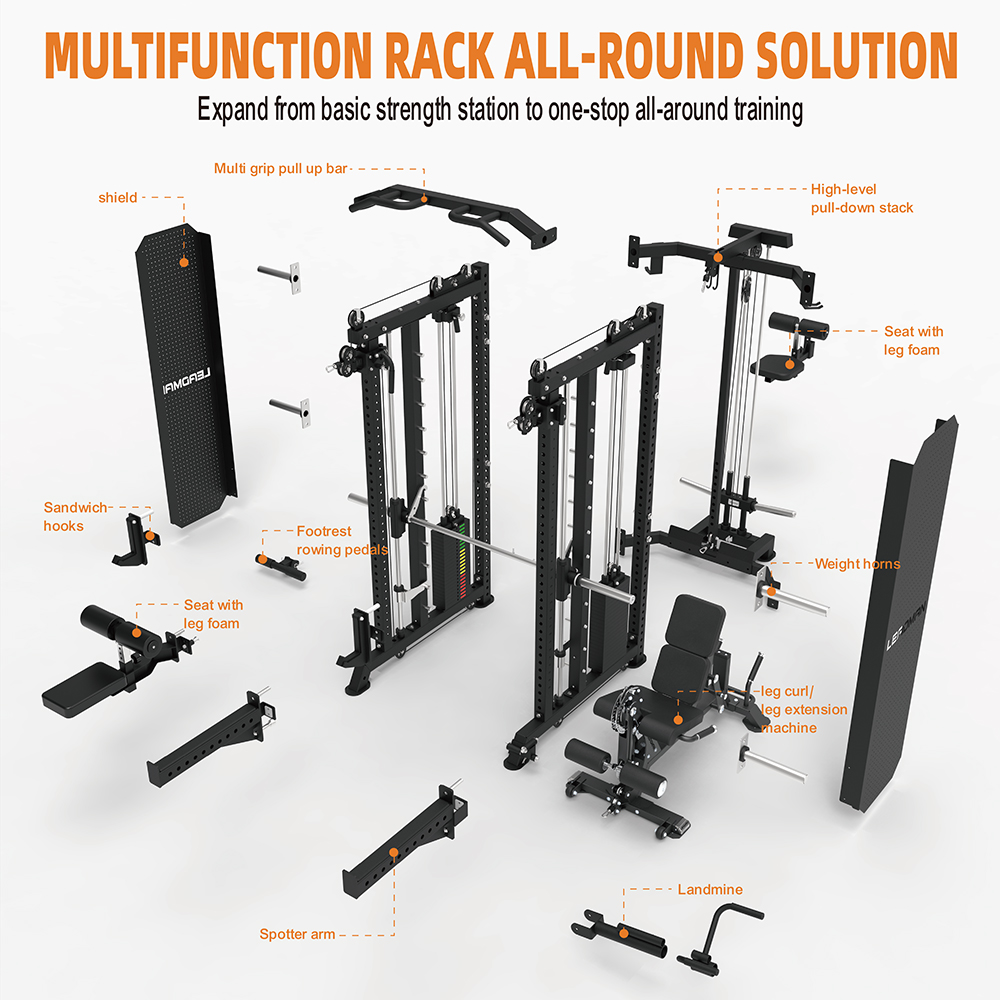
The following table shows the specific flexibility that the 9001 modular design offers for commercial procurement:
| Procurement Stage | Core Configuration | Training Functions Available | Cumulative ROI |
|---|---|---|---|
| Stage 1 | 9001 Main Unit (Smith + High/Low Pulley + Crossover) | Full-body compound training, back, chest, shoulders | High (replaces 3-4 single-function machines) |
| Stage 2 | 9001 Main Unit + 8004 Leg Attachment | Adds quadriceps and hamstring isolation, complete lower body circuit | Very High (incremental investment, doubled functionality) |
| Stage 3 | + Weight Plates and Attachments (dip bars, landmine, etc.) | Functional training, bodyweight work, powerlifting assistance | Sustainable expansion, eliminates equipment obsolescence |
Discover the complete All-in-One system:
9001 All-in-One Functional Training System
Smith machine, cable station, and leg attachment - fully integrated
Details of Technical Integration: Cord Reel Storage, Adjustable Cable, and Transport Wheels
Any equipment integration solution faces a practical problem: cable management. When a leg attachment is added to a functional trainer, poorly designed cables become not only unsightly but also a safety hazard (trip risk). The manufacturer anticipated this challenge and provided an elegant solution in the 8004's design: a built-in cord reel storage system.
The 1.2m Adjustable Steel Cable: Bridging Physical Space and Training Freedom
The core accessory of the 8004 leg machine is a 1.2-meter precision gear-adjustable steel cable. This cable is not a simple connecting line, but a precision-engineered transmission component. One end connects to the leg machine's resistance arm, while the other end uses an adjustable cable angle design to easily hook into the weight stack selector pin or low pulley connection point on the 9001 functional trainer. This means the leg attachment's resistance can completely share the 9001's weight stack system, requiring no separate plate-loading mechanism.
From a mechanical principles standpoint, this achieves true "integrated" resistance integration. Coaches can directly adjust the weight on the functional trainer's selectorized stack, and members can immediately train on the leg machine. The entire process is smooth and intuitive. The 1.2-meter length provides enough physical flexibility to install the leg attachment on the front or side of the main frame, accommodating different facility corner layouts or traffic patterns.
Integrated Cable Management: Professional Appearance and Safety Assurance
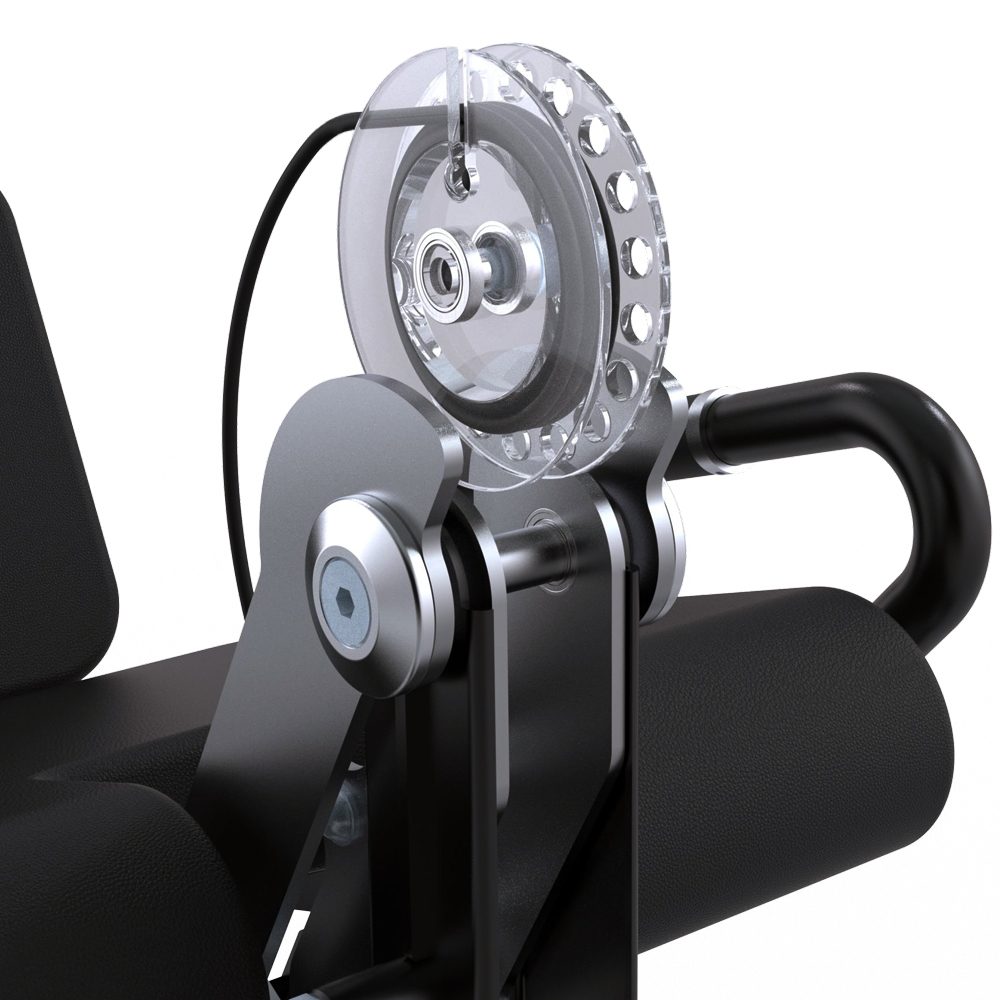
The manufacturer designed the cable to be stored in an integrated cord reel on the leg machine body when not in use. This detail is highly significant for commercial environments. A clean, obstruction-free workspace is a fundamental requirement for professional fitness facilities. Tangled cables not only reduce the facility's overall quality perception but are also a common cause of accidents. The built-in storage ensures that when the leg module is idle, its connecting cable is neatly and safely stored, protecting the cable itself from damage by foot traffic while eliminating potential safety risks.
Finally, the module is equipped with transport wheels at the base. For operators who need to regularly adjust floor layouts, perform deep cleaning, or reconfigure training zones, this is an extremely practical feature. A single person can easily move the integrated functional trainer with leg attachment over short distances, significantly reducing labor costs and the complexity of floor maintenance.
Procurement Decision Framework: Why This Integration Represents the Future Trend
From a B2B strategic perspective, adopting an "integrated functional trainer plus dedicated attachment" solution rather than purchasing scattered single-function equipment reflects a profound shift in gym operations from "owning equipment" to "providing training solutions." This model is not suitable for every facility, but for specific commercial scenarios, its advantages are overwhelming.
Target Customer Profile: Precise Positioning to Maximize ROI
The primary beneficiaries of this integrated solution are three types of commercial entities. First, high-end hotel and apartment gyms, where space is limited but users demand high equipment quality and variety. Second, private training studios and boutique gyms, where the core competitiveness lies in teaching efficiency and client experience, requiring equipment that supports efficient, one-on-one customized training. Third, functional training zones in commercial gyms, where equipment must serve both CrossFit enthusiasts needing heavy compound movements and bodybuilding clients requiring isolation exercises.
For these three customer types, traditional equipment procurement strategies often fail to meet all needs. Purchasing expensive single-function machines can overcrowd the core training area. Purchasing only a functional trainer may fail to meet lower body isolation training needs, causing members to go elsewhere. The 8004 + 9001 combination precisely fills this market gap, providing a solution that delivers both comprehensive compound training and targeted isolation work.
Total Cost of Ownership Analysis: Durability and Parts Commonality
From a TCO (Total Cost of Ownership) perspective, the advantages of an integrated solution are even more evident. First, the two units share the frame, weight stack, and part of the transmission system, meaning less metal material and manufacturing cost, savings reflected in the purchase price. Second, unified maintenance and servicing procedures. Maintenance staff only need to be familiar with one frame structure and one cable/pulley system, simplifying spare parts inventory and repair training. Finally, due to its modular nature, future upgrades only require replacing or adding specific attachments, not scrapping the entire system. This results in higher residual asset value and longer replacement cycles.
In summary, for professional fitness facilities pursuing long-term, stable, and efficient operations, investing in an integrated training ecosystem like the 8004 leg machine combined with the 9001 functional trainer is not just an equipment purchase, but a future-proof strategic decision capable of generating sustained commercial value.
Related Content:
6 Ways to Maximize ROI on Fitness Equipment Investment
Practical strategies to increase gym profitability through smart equipment combinations