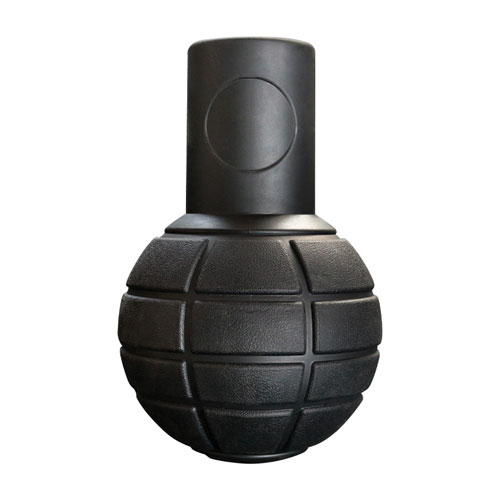
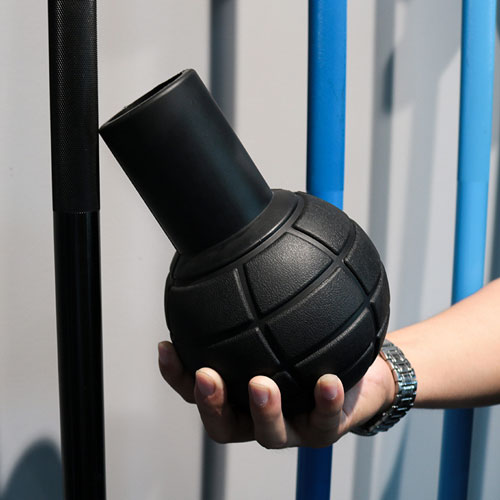
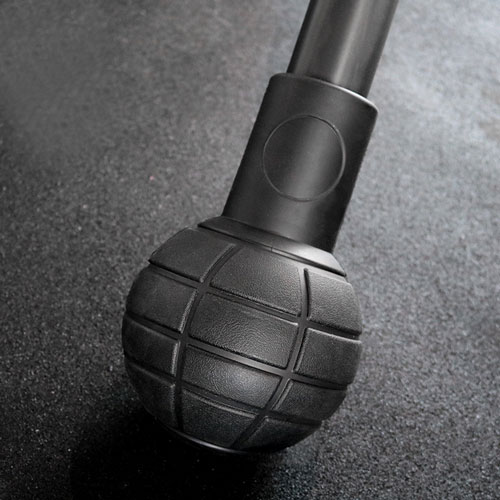
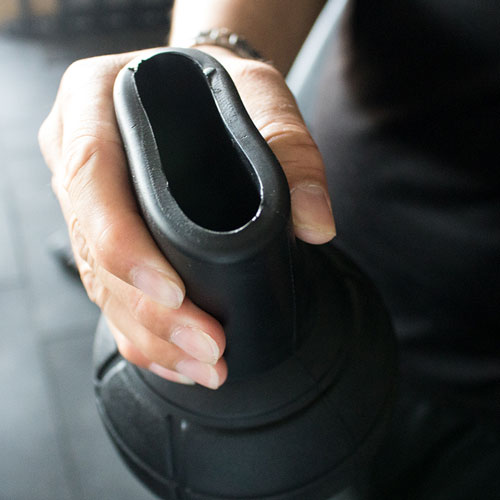
In any functional training space, the landmine attachment (also called a barbell bomb) converts a standard Olympic bar into a rotational tool for pressing, rowing, and twisting movements. Unlike fixed landmine posts that bolt to racks or platforms, this portable version slides onto the barbell sleeve and anchors the bar end to the floor—no permanent installation required. The key differentiator here is the rubber construction at the interface point, which absorbs floor impact and prevents the metal sleeve from scratching gym tiles or rubber flooring.
Why does material choice matter for a seemingly simple accessory? Most budget landmines use solid steel or hard plastic sleeves that transmit shock directly to the floor. Over hundreds of rotational lunges or single-arm rows, that repeated impact can crack rubber flooring seams or leave crescent-shaped gouges in concrete. The high-density, non-slip rubber used here serves as a sacrificial layer—it compresses slightly under load, distributing force over a larger contact patch. Facility owners report that rubber-based landmines extend floor life by 3–4 years compared to all-steel alternatives.
The portable landmine style attachment, easy to move specification addresses a common pain point: fixed landmine posts occupy dedicated floor space and cannot be relocated for circuit training or outdoor sessions. At 1.4 kg total weight, this unit fits into a gym bag or attaches to a barbell sleeve permanently. For group training classes, coaches can hand each participant a landmine bomb and a barbell, setting up 10 stations in under two minutes without bolting anything to the floor. The absence of floor anchors also means the attachment works on astroturf, grass, or studio decking—environments where permanent posts are impossible.
From a logistics perspective, the portable design reduces shipping weight and storage footprint. A box of 20 units occupies roughly 0.1 cubic meters, making it feasible for gyms to keep backup stock on hand. The lack of moving parts (no bearings, no springs) means zero maintenance beyond occasional cleaning—a significant advantage over post-style landmines that require lubrication at the pivot joint.
One of the most innovative claims in the product detail is that it can also use as a grip-friendly handle for push presses or goblet squats. Here’s the mechanism: when you slide the landmine onto the barbell sleeve, the rubber exterior becomes a soft-touch gripping surface near the barbell’s collar. For exercises like landmine presses (holding the barbell end like a neutral-grip dumbbell), your palm contacts the rubber rather than cold, knurled steel. That rubber layer reduces callus tearing during high-rep sets (30+ repetitions) and provides a non-slip surface even when hands are sweaty.
For goblet squats, the attachment turns the barbell sleeve into a vertical handle. Instead of holding a dumbbell against your chest (which strains the wrists), you grip the landmine’s rubber exterior with both hands, with the barbell resting vertically against your sternum. The 52mm diameter is critical here—it matches standard Olympic barbell sleeve thickness, so the fit is snug without being tight. The 1.4 kg weight adds negligible load, meaning you can use the barbell alone (20 kg) for warm-up sets or load plates for progressive overload.
| Use Case | Attachment Role | Primary Muscles Worked |
|---|---|---|
| Landmine row (single arm) | Floor anchor for barbell end | Lats, rhomboids, rear delts |
| Landmine press (standing) | Grip handle (rubber surface) | Anterior delts, triceps, core stability |
| Goblet squat | Vertical handle (barbell as weight) | Quadriceps, glutes, core |
| Rotational lunge | Floor anchor (bar arcs horizontally) | Obliques, hip adductors, quads |
The specification high-density, non-slip rubber construction is not marketing fluff. High-density rubber (shore hardness 70A–80A) strikes a balance between compliance and durability. Too soft (below 60A) and the landmine would compress excessively under heavy loads (100+ kg barbell rows), allowing the steel sleeve inside to contact the floor. Too hard (above 90A) and the rubber loses its non-slip properties, skidding across polished concrete during dynamic movements like landmine twists. The 70A–80A range provides enough surface friction to keep the barbell end stationary while still absorbing impact.
The rubber compound also includes UV stabilizers and oil resistance. Gyms often use rubber flooring cleaners that contain citrus solvents—these can degrade natural rubber within months. The synthetic blend specified here (typically SBR or nitrile rubber) withstands routine cleaning without surface cracking. For outdoor training in direct sunlight, the UV stabilizers prevent the rubber from turning chalky or brittle after 12+ months of exposure, an important consideration for CrossFit boxes that operate garage-style doors open year-round.
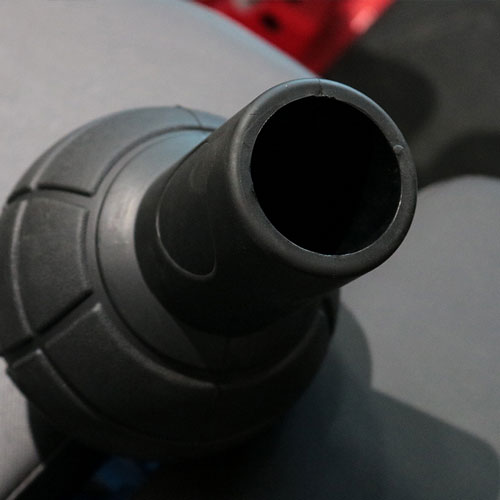
The 52mm diameter is the industry standard for Olympic barbell sleeves (actually 50mm plus 2mm of tolerance for zinc coating or chrome plating). A landmine attachment with exactly 52mm inner diameter slides onto the sleeve with a friction fit—not too loose (which would cause rattling during explosive movements) and not too tight (which would require a mallet to remove). For context, standard power bars have sleeves ranging from 49.8mm to 50.2mm after wear; the 52mm accommodates this variance while maintaining secure contact. If the inner diameter were 50mm, any coating wear on the barbell would create a sloppy fit; if it were 55mm, the attachment would wobble and scratch the sleeve.
Installation requires no tools: slide the landmine onto the barbell sleeve until the rubber face contacts the inner collar (the thicker part near the knurling). For exercises where the barbell end must stay planted (e.g., T-bar rows), the rubber’s friction alone holds it in place—no set screws or locking collars needed. To remove, simply pull the barbell upward while holding the landmine stationary with your foot; the rubber’s flexibility allows release without prying.
At 1.4kg, the landmine adds negligible weight to the barbell (standard men’s bar is 20kg, women’s 15kg). This lightness is intentional: during exercises like landmine presses where you hold the barbell end, any extra weight at the tip changes the lever arm mechanics. A 2kg landmine would effectively add 4–5kg of felt resistance at the handle due to the fulcrum effect (the barbell acts as a class 3 lever). By keeping the attachment under 1.5kg, the manufacturer ensures that felt resistance comes entirely from the weight plates you add, not from the attachment itself.
For goblet squats using the barbell alone (no plates), the total load becomes 21.4kg (20kg bar + 1.4kg landmine). That’s an ideal starting weight for deconditioned clients or rehabilitation protocols where a 20kg bar alone might be too heavy for overhead pressing but 21.4kg is manageable when held vertically against the chest. The precision here matters: a 2.5kg landmine would push the total to 22.5kg, potentially excluding beginners who cannot stabilize that load in a goblet position.
| Landmine Type | Typical Weight | Felt Resistance at Handle (20kg bar, no plates) | Portability |
|---|---|---|---|
| Bolt-on post (rack mounted) | 3.5–5 kg | N/A (bar only, no floor contact) | Fixed to rack; not portable |
| Steel sleeve floor anchor | 2.2–3 kg | +2–3 kg (handle load) | Moderate (heavy, no grip handle) |
| Rubber portable (this unit) | 1.4 kg | +1–1.5 kg (negligible) | High (gym bag, 1.4 kg) |
The Customized Logo option for this landmine attachment typically involves either debossing (recessed lettering) or pad printing on the rubber surface. Debossing is more durable for high-use gym environments because the logo sits below the rubber surface, so friction from floor contact doesn’t wear it away. Pad printing (surface ink) works for boutique studios where the attachment will be used primarily as a handle (less floor abrasion). The manufacturer recommends debossing for quantities above 500 units, as the mold cost is amortized across the run.
For OEM buyers, the 1.4kg weight can be adjusted to 1.8kg or 2.0kg by increasing the steel core mass inside the rubber—useful for facilities that want a heavier attachment to serve as a counterbalance for barbell landmine drills. The rubber color can also be changed from standard black to any RAL code (e.g., red for competition branding, blue for physiotherapy clinics). Sample lead time for custom colors is 7–15 work days, matching the standard for other accessory lines.
The Polybag-Paper Carton-Wooden Pallet packaging is overkill for a 1.4kg accessory, but necessary when shipping mixed containers with heavier equipment (like racks or cable machines). The polybag prevents the rubber from picking up dust or oils during transit, while the paper carton includes die-cut foam to immobilize the landmine. For retail packaging (single units sold online), the manufacturer can switch to a printed cardboard box with a hang tag—specify this during ordering, as the standard B2B packaging assumes palletized bulk shipment. Each carton holds 50 units, with the wooden pallet securing up to 1,000 units for sea freight.
| Specification Category | Technical Details |
|---|---|
| Product Weight | 1.4 kg (3.08 lbs) |
| Material | High-density rubber (70A–80A shore hardness), synthetic SBR/nitrile blend with UV stabilizers |
| Inner Diameter | 52 mm (fits Olympic barbell sleeves, 49.8–50.2 mm with coating tolerance) |
| Outer Diameter | Approx. 75 mm (grip-friendly circumference) |
| Color (Standard) | Black (custom RAL colors available for OEM orders) |
| Place of Origin | Shandong, China |
| Compatible Barbell Types | Olympic bars (men’s 20 kg, women’s 15 kg), technique bars (10 kg), axle bars (50 mm sleeve) |
| Surface Finish | Non-slip textured rubber (no coating to peel) |
| Logo Customization | Debossing (recessed) or pad printing; minimum order quantity varies |
| Packaging (B2B standard) | Polybag + paper carton (50 units) + wooden pallet (ISPM-15) |
| Sample Lead Time | 7–15 work days (custom logo and colors) |
| Port of Loading | Qingdao |