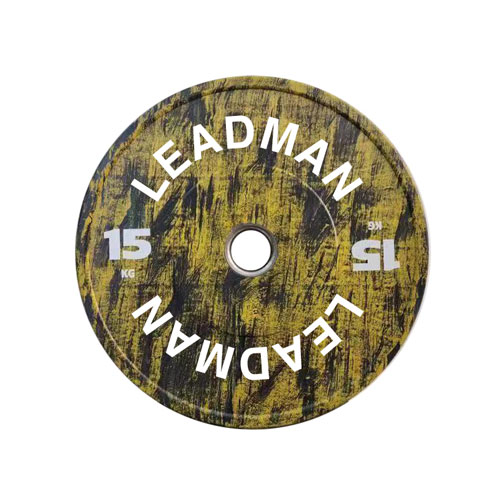
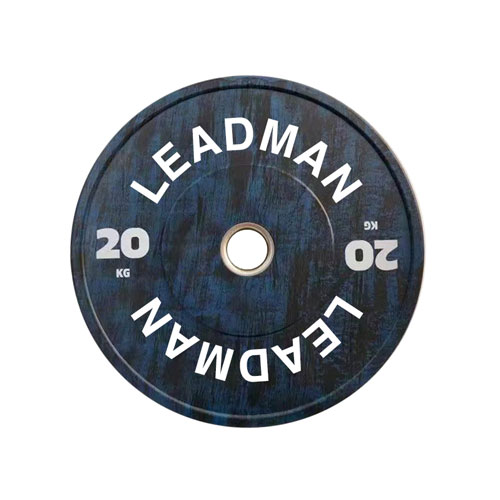
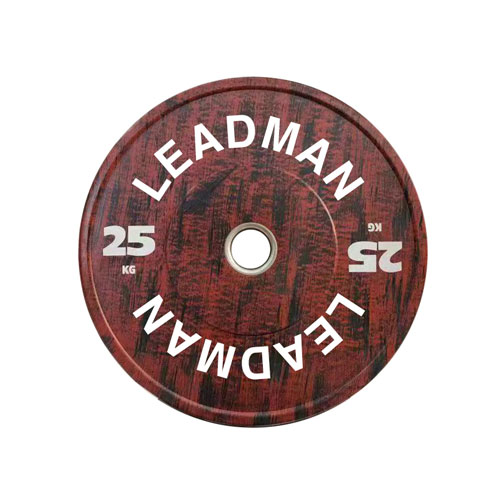
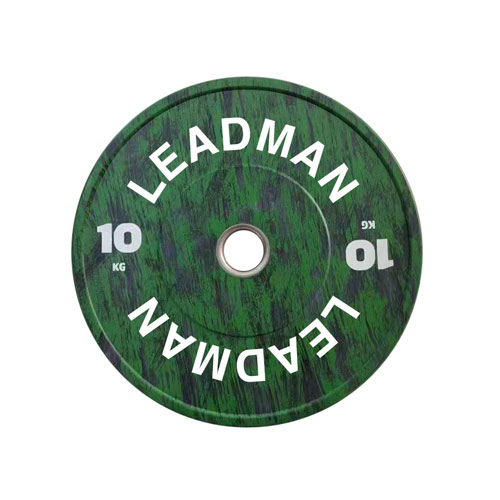
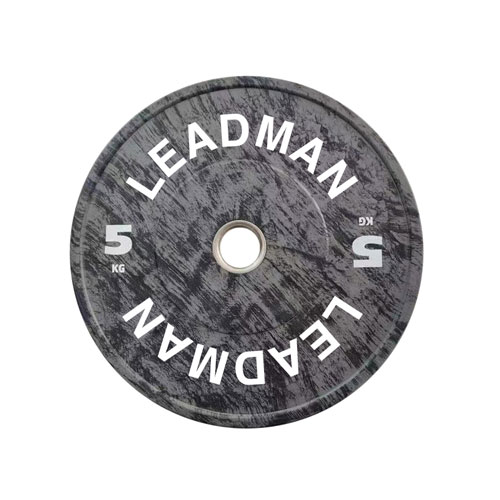
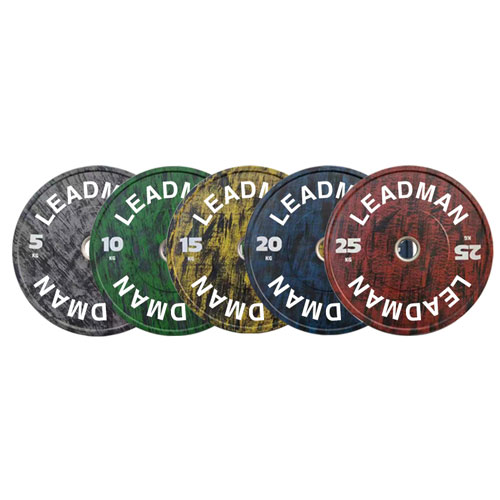
Most bumper plates fall into two categories: utilitarian black rubber or bright solid colors. The wood grain rubber bumper plate creates a third category—equipment that performs to IWF standards while adding natural aesthetics to any gym. The wood grain pattern is not a painted decal or vinyl wrap; it is a multi-layer colored rubber compound molded directly into the plate surface. This means the grain pattern will not peel, scratch off, or fade over time, even after thousands of drops. For boutique studios, hotel gyms, or high-end home training spaces, wood grain plates signal attention to design without compromising on the durability required for daily Olympic lifting.
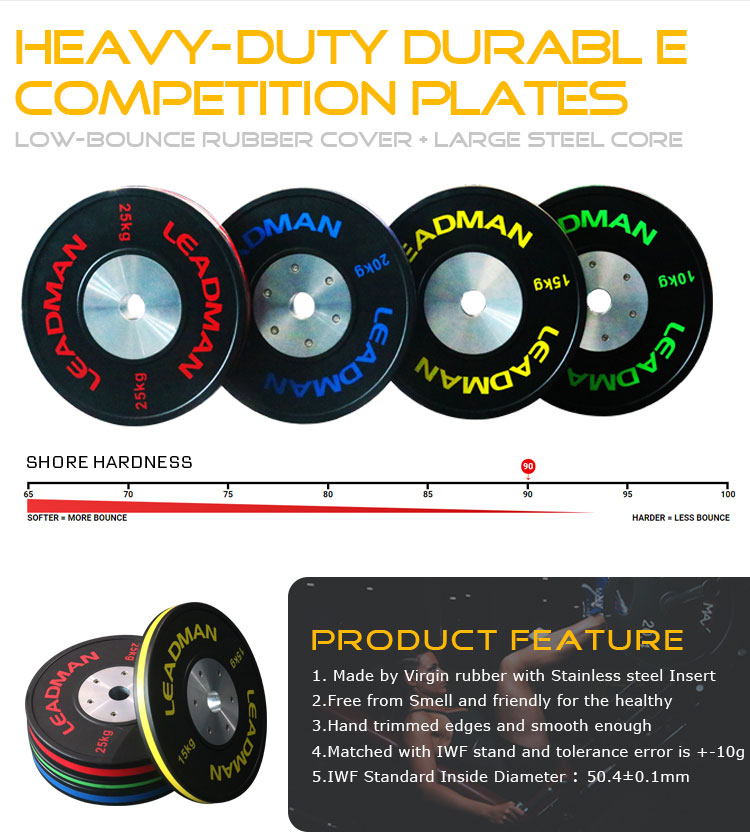
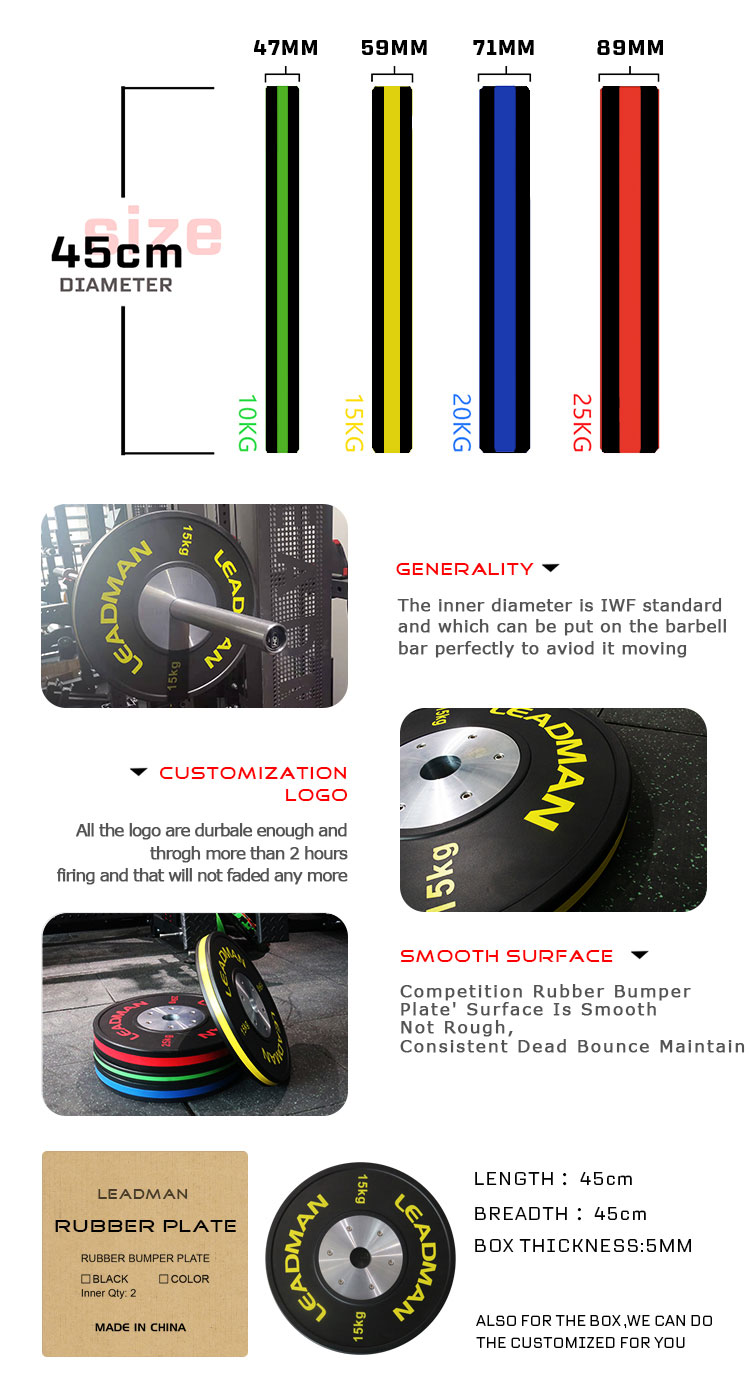
Under the aesthetic surface lies a rubber bumper plate engineered to the same specifications as competition-grade equipment: 450mm diameter (IWF standard), 50.6mm±0.2mm inner diameter for a stable fit on Olympic barbells, and a hardness range of 75-95 Shore A that can be customized to your preferred durometer. The wood grain finish is available across the full weight spectrum from 5kg to 25kg (and 10-55lb), making it possible to outfit an entire gym rack with plates that look like fine furniture but survive repeated overhead drops.
The first design principle—no odor, low noise, suitable for personal and gym use—addresses two common complaints about rubber bumper plates. Low-quality rubber (often recycled tire rubber) emits a strong sulfur or petroleum smell for weeks or months, particularly in warm or poorly ventilated spaces. These wood grain plates use virgin rubber compounds with low volatile organic compound (VOC) content. The result: you can unpack the plates and use them immediately in a home gym or studio without an air-out period. For commercial gyms, the absence of odor prevents member complaints and allows the plates to be stored in enclosed racks without the smell permeating the workout area.
The low noise characteristic comes from the rubber formulation's internal damping properties. When dropped from overhead, the plate's 75-95 Shore A hardness absorbs impact energy efficiently, producing a dull thud rather than a sharp crack or ringing sound. Plates at the softer end of the range (75 Shore A) are approximately 30% quieter than standard competition plates (90-95 Shore A), making them suitable for apartment gyms or late-night training where noise restrictions apply. The trade-off: softer plates may bounce slightly more and have a shorter lifespan under very high-volume use (10,000+ drops per year).
The specification color rubber combined and will not fade. Accept color custom reveals the manufacturing process. Unlike painted plates where a wood grain decal is applied to a black rubber base, these plates are compression-molded from multiple colored rubber compounds simultaneously. The wood grain effect is created by layering brown, tan, and amber rubber strips in the mold before applying heat and pressure. The result is a solid rubber plate where the color runs all the way through—scratches or scuffs do not reveal a different color underneath. This "color through" construction is the same process used for high-end competition colored bumper plates (e.g., Rogue Echo or Eleiko XF), but here applied to a wood grain aesthetic.
The richer color combinations, personalized customization principle means you are not limited to standard wood tones. Custom orders can match specific wood species (walnut, oak, maple, cherry) or create entirely non-wood patterns (marble, carbon fiber, camouflage) by combining colored rubber strips. The manufacturer's minimum order quantity for full custom color combinations is 50 plates per weight (MOQ: 50pcs as listed), but sample plates with simplified patterns can be produced in 7-15 work days.
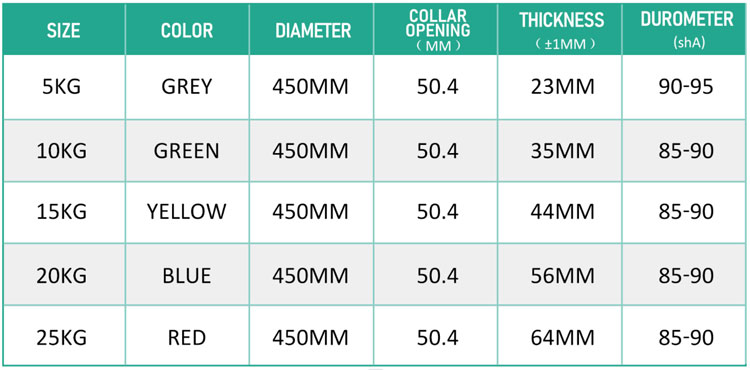
| Weight (kg) | Thickness (approx.) | Diameter (mm) | Inner Diameter (mm) | Hardness Range (Shore A) | Standard Color | lb Equivalent |
|---|---|---|---|---|---|---|
| 5 kg | 26-28 mm | 450 mm | 50.6±0.2 mm | 75-95 customizable | Wood grain | 10 lb |
| 10 kg | 32-35 mm | 450 mm | 50.6±0.2 mm | 75-95 customizable | Wood grain | 22 lb |
| 15 kg | 45-48 mm | 450 mm | 50.6±0.2 mm | 75-95 customizable | Wood grain | 33 lb |
| 20 kg | 58-62 mm | 450 mm | 50.6±0.2 mm | 75-95 customizable | Wood grain | 44 lb |
| 25 kg | 70-75 mm | 450 mm | 50.6±0.2 mm | 75-95 customizable | Wood grain | 55 lb |
The drop test result—up to 50% of the weight can be removed—is a critical performance metric. This means that after the plate is dropped from overhead (approximately 2.5 meters for a snatch or clean drop), the rubber rebounds and compresses in a way that up to half of the impact energy is dissipated as heat rather than returning to the barbell or floor. Plates with lower rebound (e.g., 75 Shore A) remove closer to 50% of the weight's kinetic energy, resulting in a softer, quieter drop. Plates with higher hardness (95 Shore A) remove less energy (approximately 30-35%) but bounce less and feel more stable during the pull.
The ability to customize hardness from 75-95 Shore A allows facility owners to tune the plates to their specific use case:
The hardness customization applies to the entire plate, not just the surface. The wood grain pattern remains unaffected across the hardness range because the colored rubber compounds share the same durometer.
The IWF standard plate designation is not marketing—it is a precision engineering specification. The 450mm diameter ensures that all plates in the set (5kg to 25kg) have identical outer dimensions, so the barbell height off the floor remains constant regardless of which plates are loaded. This is essential for Olympic weightlifting because even a 5mm variation in plate diameter changes the start position of the first pull. The inner diameter 50.6mm±0.2mm is equally critical: Olympic barbell sleeves are 50mm diameter. The 0.6mm clearance allows the plate to slide onto the sleeve without binding, but the ±0.2mm tolerance keeps the fit snug enough to prevent the plate from tilting or wobbling during explosive movements.
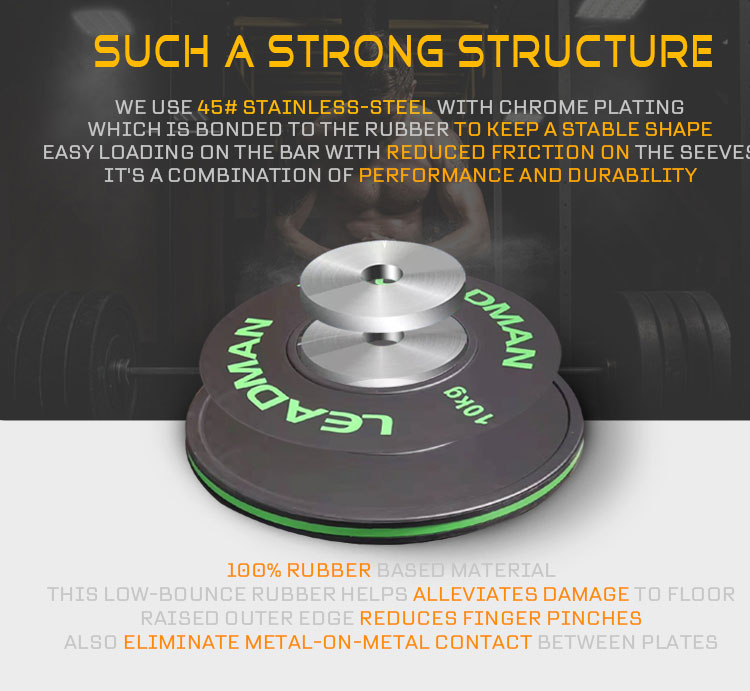
The phrase stable on the barbell bar refers to the combination of the tight inner diameter tolerance and the plate's full-rubber construction. Unlike iron plates with rubber coatings (where the steel insert can develop play over time), these solid rubber plates maintain their hole tolerance for the life of the plate. The inner Oxy 2 marking (visible on the product label) may indicate a two-part inner ring design: a brass or stainless steel insert encased in rubber, which prevents the inner hole from ovalizing under repeated drops. This insert also protects the barbell sleeve from direct rubber-to-metal friction, which can leave residue on the sleeve.
| Shore A Hardness | Best For | Drop Noise Level | Bounce Height (approx.) | Expected Lifespan (drops/year 5000) | Energy Removal (drop test) |
|---|---|---|---|---|---|
| 75-80 | Home gyms, apartments, hotels | Very low (muted thud) | 5-10 cm | 3-5 years | 45-50% |
| 81-87 | Commercial gyms, CrossFit boxes | Low to moderate | 2-5 cm | 6-8 years | 38-44% |
| 88-95 | Weightlifting clubs, competition training | Moderate (sharp thud) | Under 2 cm | 8-10+ years | 30-35% |
The surface of particles description indicates a slightly textured finish, not a smooth, glossy surface. This texture serves two purposes. First, it prevents plates from sticking together when stacked in storage—smooth rubber plates can create a vacuum seal against each other, requiring force to separate. The particle texture creates micro-gaps that allow air to flow between stacked plates. Second, the texture increases grip when handling plates for loading and unloading; smooth plates can slip from sweaty hands when carrying multiple plates at once.
The surface is more delicate and smooth (from the design philosophy) seems contradictory, but in context it means that despite the particle texture, the finish is not rough or abrasive. The particles are rounded, not sharp, so the plates will not scratch your hands, arms, or the barbell sleeves. This balance between grip and smoothness is achieved through post-molding tumbling—the plates are rotated in a drum with polishing media to knock down any sharp flash from the mold lines while preserving the texture.
The design principle of longer service life, higher cost performance is realized through three factors. First, the virgin rubber compound (not recycled tire rubber) resists dry rot and cracking for 5+ years longer than recycled alternatives. Second, the color-through construction means aesthetics do not degrade with use—scratches do not reveal a different color, and the wood grain pattern remains visible even as the surface acquires minor scuffs. Third, the replaceable inner ring (inner Oxy 2) extends the plate's life by preventing the center hole from enlarging—the most common failure mode for rubber plates is a loose center hole that causes the plate to rattle on the barbell.
Cost performance is calculated over the plate's lifespan. A cheap recycled rubber plate might cost 40% less upfront but need replacement after 2-3 years in a commercial gym. A wood grain plate with virgin rubber and a replaceable inner ring costs more initially but lasts 6-10 years—making the per-year cost 30-50% lower. For gym owners, this trade-off favors the higher-quality plate, especially for 25kg plates that see the most frequent dropping.
The polybag-paper carton-wooden pallet packaging is standard for bumper plate shipments. Each plate is individually sealed in a polybag to prevent the rubber surfaces from fusing together during hot container transit (temperatures inside shipping containers can exceed 60°C, causing raw rubber to adhere to itself). The plates are then stacked in a 5-ply corrugated paper carton with foam dividers between plates. For the 450mm diameter plates, the carton dimensions are approximately 48cm × 48cm × (stack height + 5cm). The cartons are strapped to a wooden pallet (ISPM-15 certified) with corner protectors. A typical 20ft container holds 250-300 pairs of 25kg plates (500-600 individual plates) on 20 pallets.
The sample time: 7-15 work days applies to custom wood grain patterns and hardness specifications. Stock wood grain plates (standard walnut or oak pattern, 85 Shore A hardness) may ship faster. Minimum order quantity is 50pcs (individual plates, not pairs), meaning 25 pairs of a given weight. Mixed weight orders (e.g., 20 pairs of 15kg + 30 pairs of 20kg) are accepted as long as total plates exceed 50.
| Specification Category | Technical Details |
|---|---|
| Product Type | Wood grain rubber bumper plate (virgin rubber, color-through construction) |
| Weight Range | 5kg / 10kg / 15kg / 20kg / 25kg (10-55lb equivalents available) |
| Outside Diameter | 450 mm (17.72 inches) – IWF competition standard |
| Inner Diameter | 50.6 mm ±0.2 mm – fits Olympic 50mm barbell sleeves |
| Thickness by Weight | 5kg: 26-28mm | 10kg: 32-35mm | 15kg: 45-48mm | 20kg: 58-62mm | 25kg: 70-75mm |
| Hardness (Shore A) | Customizable range 75-95 Shore A (select based on noise/drop preference) |
| Drop Test Performance | Up to 50% energy removal (hardness dependent) |
| Material | Virgin rubber compound (no recycled tire rubber), low VOC, no odor |
| Colors (Standard) | Black / Grey / Green / Yellow / Blue / Red + wood grain pattern |
| Surface Finish | Textured particle surface (non-slip, prevents plate adhesion) |
| Inner Ring | Inner Oxy 2 – two-part brass/stainless steel insert prevents hole ovalization |
| Place of Origin | Shandong, China |
| Application | Commercial gyms, weightlifting clubs, CrossFit boxes, high-end home gyms |
| MOQ | 50 plates (individual units, not pairs) |
| Logo Customization | Customized logo available (debossed or printed) |
| Packaging | Individual polybag + 5-ply paper carton + ISPM-15 wooden pallet |
| Sample Lead Time | 7-15 work days (custom wood grain patterns may extend timeline) |
| Port of Loading | Qingdao, China |