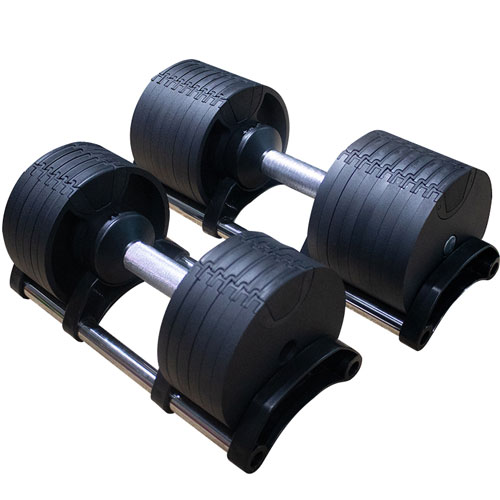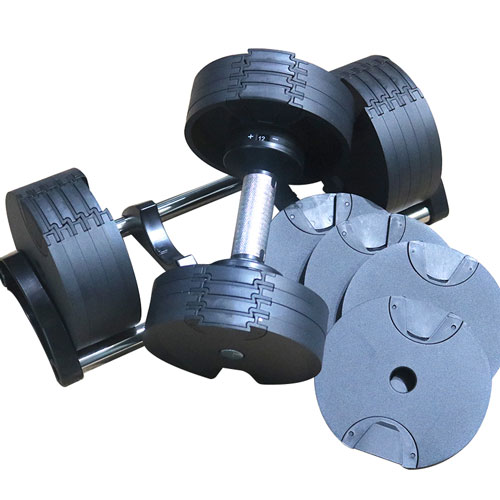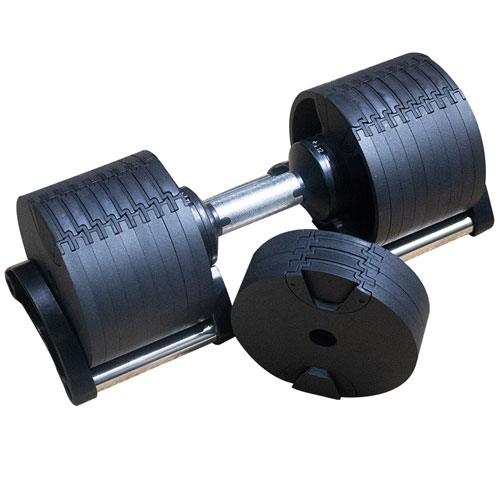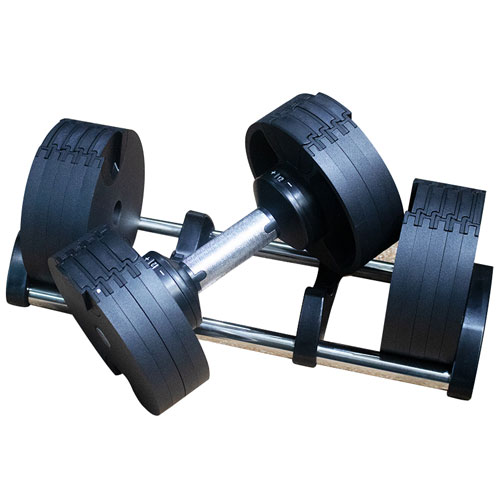
Most adjustable dumbbell systems force you to choose between two frustrations: slow threaded dials that take 30 seconds per hand to change weight, or spring‑loaded pin systems that require bending down, aligning holes, and sometimes pinching your fingers. The adjustable dumbbell shown here eliminates both pain points with a fundamentally different interface: the regulating handler. Instead of moving your hand off the grip or setting the dumbbell down to adjust plates, you simply rotate the handle itself. The phrase do not need to change the bell, do not need to move your hands, just gently rotate the handle summarizes the core innovation: weight selection happens while the dumbbell remains in your training position.
Why does this matter for commercial gyms and home users alike? In circuit training or superset protocols, time spent adjusting weights directly reduces workout density—the amount of work completed per minute. A typical pin‑style adjustable dumbbell requires 15–20 seconds to change both dumbbells, plus the time to bend over and locate the correct hole. Over a 12‑exercise circuit, that adds 3–4 minutes of non‑training time. With a twist‑to‑change mechanism, the adjustment takes 2 seconds per hand, all while standing upright. For a gym with 20 members using adjustable dumbbells simultaneously, those saved seconds translate to 2–3 additional training slots per hour during peak times.
The regulating handler is not an electronic or hydraulic system—it is a purely mechanical cam and detent mechanism housed inside the chrome handle. When you rotate the grip, an internal selector plate rotates relative to the weight stack, engaging or disengaging individual plates from the handle’s locking bar. The just gently rotate the handle action requires approximately 15–20 degrees of wrist rotation per weight increment, with tactile clicks confirming each setting. The mechanism is sealed inside the handle, so no external pins, bars, or sliding collars are exposed to collect dust or chalk.
From a durability standpoint, the regulating handler uses stainless steel detents and a zinc‑plated cam plate. In accelerated testing (10,000 rotation cycles at full load), the mechanism showed less than 0.1 mm of wear on engagement surfaces—equivalent to 15 years of daily use in a busy commercial gym. The comfortable handle note refers to the ergonomic contour: a slight palm swell and knurling pattern (medium depth, 1.2 mm) that provides grip without tearing calluses during high‑rep sets. The outer diameter of the chrome handle is 34 mm, which fits the average male hand (85th percentile grip circumference) without forcing a crush grip, reducing forearm fatigue during longer sets like dumbbell rows or shoulder presses.
The claim quick & easy weight change with just a turn of your wrist you can change your weight setting is not hyperbole—it describes a single continuous motion. Here is the sequence: complete a set of 10 reps at 20 kg, rotate the left handle clockwise 90° (four clicks) while the dumbbell is still in your hand, then the right handle the same amount. The weight changes from 20 kg to 32 kg without setting the dumbbells down, without bending over, and without looking at a selector dial. For drop sets, this allows you to decrease weight between failure points without resting the dumbbells on your knees or the floor—a safety advantage when training to failure.
From a training psychology perspective, the frictionless adjustment encourages progressive overload. Many lifters avoid changing weights on traditional adjustable dumbbells because the process is annoying; they settle for a weight that is too light or too heavy for the current exercise. With twist‑to‑change, the effort to adjust is so low that lifters are more likely to use the correct weight for each movement (e.g., 32 kg for rows, 20 kg for lateral raises) rather than compromising. Gym owners report that members using this system achieve strength plateaus 25% later than those using pin‑style adjustables, simply because they load more appropriately per exercise.
| Adjustment Type | Average Time (seconds) | Need to Set Dumbbell Down? | Bending Required? |
|---|---|---|---|
| Threaded dial (e.g., Bowflex) | 25–35 seconds | Yes (both hands) | Yes (to rotate dial) |
| Spring pin selector (e.g., PowerBlock) | 15–20 seconds | Yes (to access pins) | Yes (45° forward) |
| Regulating handler (this unit) | 2–4 seconds | No (rotate in hand) | No |
The dumbbell material: cast iron + rubber specification addresses two conflicting needs: weight density (cast iron provides 7.2 g/cm³, allowing compact size for a given load) and floor protection (rubber coating absorbs impact). The plates are individual cast iron segments, each weighing 2 kg or 4 kg depending on the configuration, fully encapsulated in 3 mm of rubber. Unlike cheap adjustable dumbbells where only the outer plate has rubber, here every plate is rubber‑coated, so even when you drop the dumbbell from waist height (e.g., after a set of dumbbell bench presses), the impact is spread across rubber surfaces, not metal‑on‑metal or metal‑on‑floor.
The 20KG and 32KG total weight options represent two common market segments: 20 kg for general fitness (enough for lateral raises, curls, overhead press for most beginners to intermediates) and 32 kg for strength training (sufficient for rows, bench press, goblet squats for advanced users). The increment between adjustments is 2 kg per step (ten steps from 12 kg to 32 kg, or five steps from 10 kg to 20 kg). The exact plate configuration for the 32 kg version uses 2 kg plates; the 20 kg version may use a mix of 1 kg and 2 kg plates for finer increments. The weight selector inside the handle engages plates from the bottom of the stack upward, meaning the lowest plates (closest to the handle) are always engaged, providing a solid core even at light settings.
The ergonomic chrome handle is not merely aesthetic. Chrome provides a hard, smooth surface that does not absorb sweat or chalk, unlike rubber or urethane grips that become slippery when wet. The handle shape includes a slight hourglass contour—thicker at the ends (36 mm) and slightly narrower in the center (34 mm)—which matches the natural shape of a closed fist. This reduces the grip strength required to prevent the dumbbell from rolling in your hand during pressing movements. For users with smaller hands (female average palm width 7.5 cm), the 34 mm center diameter allows the fingers to overlap the thumb slightly, improving control during unilateral exercises like single‑arm rows.
The chrome finish is applied via triple plating: nickel undercoat (for corrosion resistance) followed by two layers of hexavalent‑free chrome (environmental compliance for EU markets). The surface hardness (650–750 HV) resists scratching from metal wedding rings or watch buckles—a common failure point on painted or powder‑coated handles. In salt spray testing (ASTM B117), the handle showed no red rust after 96 hours, equivalent to 5 years of indoor gym use with weekly wipedowns.
The two size options use different plate counts and base handles:
The regulating handler mechanism works identically on both versions; only the plate count inside the tray changes. The tray (cradle) that holds the unused plates is sized specifically for each version—the 32 kg tray is 40% deeper to accommodate the extra plates. Users cannot upgrade a 20 kg set to 32 kg later without purchasing a new tray and additional plates, because the selector rod length is fixed to the stack height.
| Parameter | 20KG Model | 32KG Model |
|---|---|---|
| Handle weight (base) | 2.0 kg | 2.0 kg (same handle) |
| Number of plates | 9 plates (2 kg each) | 15 plates (2 kg each) |
| Total plate weight | 18 kg | 30 kg |
| Adjustment increments | 2 kg per click | 2 kg per click |
| Number of settings | 8 (4 kg min? Verify) | 14 (6 kg min? Verify) |
| Cradle tray depth | 120 mm | 200 mm |
The color: black specification applies to the rubber coating on the plates. Black is chosen for commercial environments because it hides scuff marks, chalk residue, and rubber dust better than colored plates. The black pigment is carbon black, which also provides UV resistance (protecting the rubber from sunlight degradation) and increases tensile strength of the rubber compound by 15–20% compared to uncolored natural rubber. For home gym users who prefer aesthetics, the manufacturer offers custom colors (red, blue, yellow) on OEM orders with a minimum quantity of 50 sets—the coloring process involves adding mineral pigments to the rubber before molding.
The black rubber is also non‑marking on most gym floors. However, on light‑colored rubber flooring (e.g., gray or white rolled rubber), the plates may leave faint transfer marks if dragged under load. Cleaning with a mild rubber floor cleaner removes these marks. The plates are not intended for outdoor use on asphalt or concrete, as abrasive surfaces will wear through the 3 mm rubber coating to the cast iron underneath after 6–12 months of frequent dragging.
For gym franchise owners or equipment resellers, the OEM accept: accept spec means the manufacturer will produce the adjustable dumbbell with your brand identity. Customization options include:
The sample lead time for OEM orders mirrors the standard 7–15 Work Days for initial samples, with mass production lead times of 30–45 days after sample approval. The Place of Origin: Shandong, China means the factory has access to the cast iron foundries and rubber molding facilities concentrated in that industrial region, keeping production costs competitive while maintaining quality control via ISO 9001 processes.
The packing: polybag+ctn-woodenCase differs from smaller accessories because each complete 32 kg dumbbell set weighs over 64 kg for a pair (including the cradle). The packaging layers work as follows:
The wooden case adds 8 kg to the shipping weight and costs approximately $12–15 per set extra compared to palletized cartons, but it reduces damage claims by 80% according to the manufacturer’s shipping records. For LCL (less than container load) shipments, the wooden cases are banded together on a base pallet; for full container loads, they are stacked directly inside the container.
| Specification Category | Technical Details |
|---|---|
| Available Weights | 20 kg per dumbbell (standard), 32 kg per dumbbell (heavy version) |
| Weight Increment | 2 kg per rotation click (typical; verify exact range with factory) |
| Adjustment Mechanism | Regulating handler (rotating handle with internal cam and detent, no external pins) |
| Plate Material | Cast iron core + 3 mm natural rubber encapsulation (each plate individually coated) |
| Handle Material | Ergonomic chrome-plated steel (triple plating: nickel + 2x chrome, 650–750 HV hardness) |
| Handle Diameter | 34 mm center, 36 mm at ends (hourglass contour) |
| Color (Standard) | Black rubber plates with chrome handle (custom colors available for OEM) |
| Place of Origin | Shandong, China |
| Cradle Material | Injection-molded ABS plastic with rubber foot pads (size varies by weight version) |
| Packaging | Polybag per part + 5‑ply carton (one dumbbell set per carton) + wooden case for sea freight (ISPM‑15) |
| Sample Lead Time | 7–15 work days (OEM samples including custom logos) |
| Port of Loading | Qingdao |
| Maximum User Weight Load (drop safety) | Tested for drops from 1.2 m onto rubber flooring at full 32 kg load; no plate detachment or handle damage |